Motion Mamba 2.0 brings open-source long-horizon control to humanoids
Motion Mamba 2.0 combines autoregressive diffusion and Mamba architecture to enable long-horizon humanoid control.
2 min read, Wednesday, 25 November
Source page video
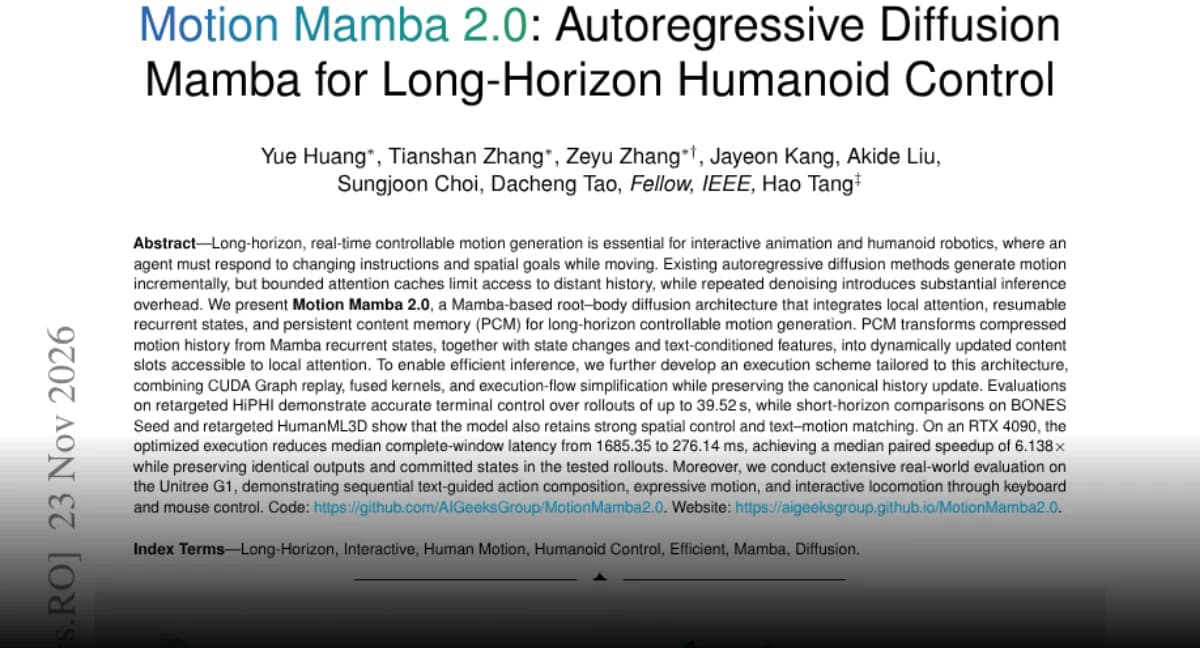
Demonstration of long-horizon humanoid motion generation using Motion Mamba 2.0.
Controlling humanoid robots over extended periods of time requires systems that can adapt to changing instructions and spatial goals without losing track of past movement. Traditional approaches often struggle with either memory limitations over long sequences or heavy processing overhead during inference. Motion Mamba 2.0 addresses these challenges by integrating state-space models with diffusion techniques specifically for root-body motion generation.
Key facts
- Model Name
- Motion Mamba 2.0
- Hardware
- RTX 4090
- Robot Tested
- Unitree G1
- Maximum Rollout
- 39.52 s
- Median Speedup
- 6.138x
- Latency Reduction
- 1685.35 to 276.14 ms
Architecture and Memory Management
The core of the system relies on a combination of local attention, resumable recurrent states, and persistent content memory. Persistent content memory transforms compressed motion history from Mamba recurrent states, along with text-conditioned features and state changes, into dynamically updated slots that local attention can access.
To make this architecture practical for real-time applications, the developers implemented a custom execution scheme. This setup combines CUDA Graph replay — a technique that records and replays GPU instruction sequences to reduce CPU overhead — with fused kernels and simplified execution flows. These optimizations preserve the standard history update while dramatically cutting down processing latency.
Open Source Release and Real-World Tests
Evaluations show that the architecture maintains accurate terminal control over rollouts lasting up to 39.52 seconds. When tested on an RTX 4090 graphics card, the optimized execution scheme reduces the median complete-window latency from 1685.35 to 276.14 milliseconds. This represents a median paired speedup of 6.138 times while keeping model outputs identical.
The project team has made the codebase, trained models, and training data fully open source. Real-world tests on the Unitree G1 humanoid demonstrated sequential text-guided action composition, expressive motion generation, and interactive locomotion controlled via standard keyboard and mouse inputs.
Source: Original announcement
Worth a read?

Comments