Meituan releases LongCat-2.5, a 1.6-trillion-parameter agent model trained on Chinese hardware
Meituan has released the model weights for LongCat-2.5, a massive multimodal agent model trained entirely on domestic Chinese hardware.
2 min read, Sunday, 15 November

Chinese food delivery company Meituan has released the weights for LongCat-2.5, a 1.6-trillion-parameter model built specifically for autonomous AI agents. The model was trained entirely on domestic Chinese hardware and approaches the performance of leading Western systems on several coding benchmarks.
Key facts
- Total parameters
- 1.6 trillion
- Active parameters
- 48 billion
- Context window
- 1 million tokens
- Max output length
- 128,000 tokens
- License
- MIT
- Input price
- €0.27 per million tokens
- Score
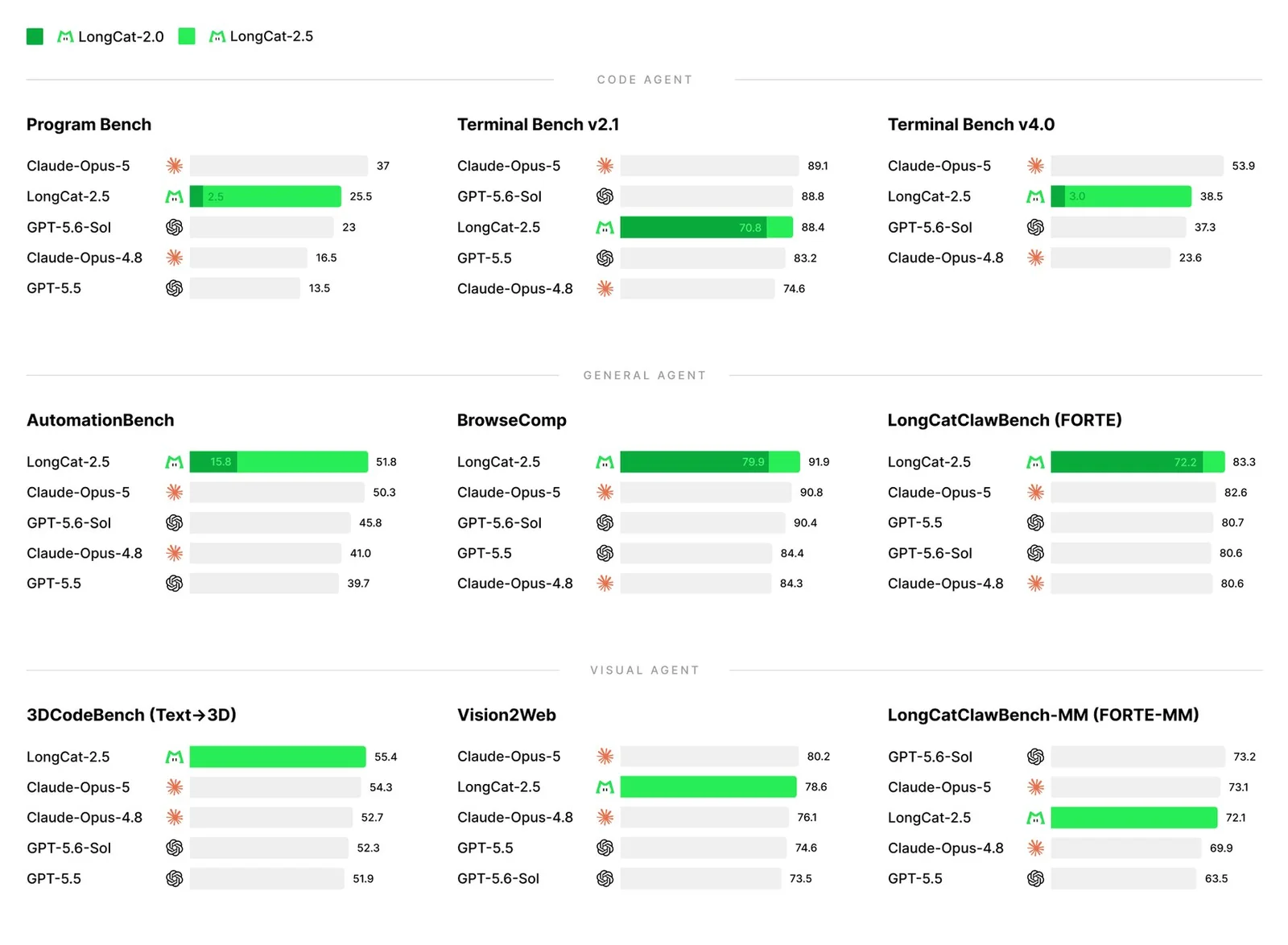
- LongCat-2.5: 88.4
- Claude Opus 5: 89.1
- GPT-5.6 Sol: 88.8
- Deepseek-V4.1-Flash: 90.6
| Metric | LongCat-2.5 | Claude Opus 5 | GPT-5.6 Sol | Deepseek-V4.1-Flash |
|---|---|---|---|---|
| Score | 88.4 | 89.1 | 88.8 | 90.6 |
Architecture and Capabilities
LongCat-2.5 is a mixture-of-experts model — an architecture where the system routes each token to specialized sub-networks to save computing power. Out of 1.6 trillion total parameters, roughly 48 billion are active for each token processed. The model handles text, images, and video, processes up to one million tokens via its API, and generates responses up to 128,000 tokens long. Users can also toggle reasoning capabilities on and off.
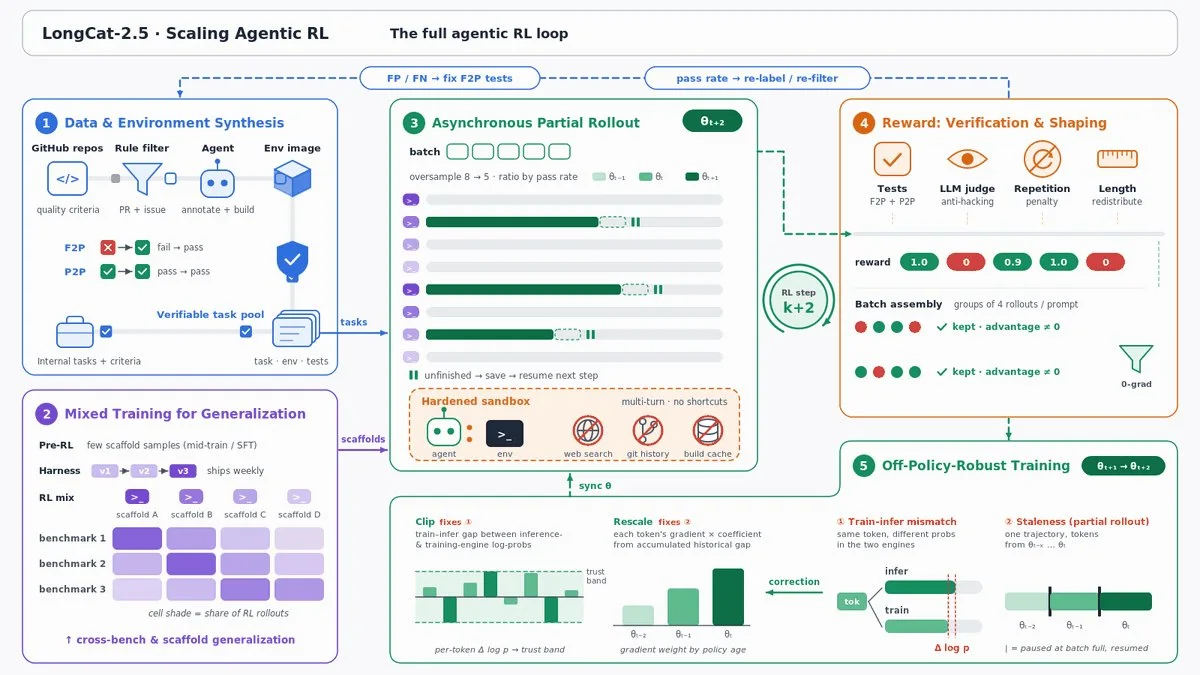
Instead of bolting on a separate image encoder, LongCat-2.5 converts images directly into tokens that are processed alongside text. For training, the developers used real software tasks from GitHub pull requests, blocked internet access in training environments, and distilled capabilities from several specialized teacher models.
Hardware and Deployment
Meituan quantizes the expert weights and activations to 4-bit precision, a format that Chinese chips can process natively. A sample self-hosted deployment runs on a cluster of 194 Huawei Ascend accelerators from the Atlas A2 series. Two chips handle image processing, 64 handle prompt ingestion, and 128 handle response generation. The self-hosting guide contains no configuration guidance for Nvidia graphics processing units.
The model weights are available under the MIT license. Meituan offers the model through an API that supports both OpenAI and Anthropic formats, alongside a chat interface at longcat.ai.
Benchmark Performance
On Terminal Bench v2.1, a test measuring command-line task resolution, LongCat-2.5 scores 88.4 points, trailing models like Claude Opus 5 and GPT-5.6 Sol. On DeepSWE, which evaluates bug fixing in real code repositories, the model scores 64.6 points. However, it achieves 91.9 points on BrowseComp, a web search benchmark.
Source: Original announcement
Worth a read?

Comments