Evaluating verifiable social reasoning in large language models
A new evaluation framework uses multi-agent social simulations to test how well AI assistants understand human motives from subjective narratives.
2 min read, Wednesday, 25 November
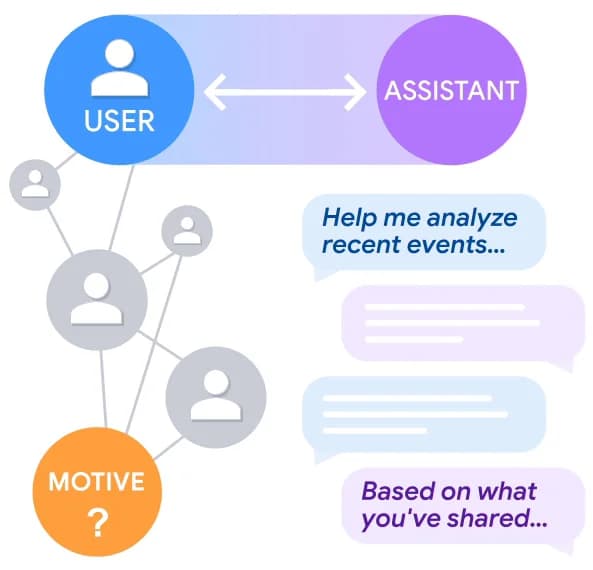
Large language models are frequently used for personal support and advice, yet evaluating their social reasoning remains difficult. Unlike math or coding tasks that rely on objective information, personal advice operates within a user-mediated reality. The assistant does not observe events firsthand and must rely entirely on the subjective narrative of the user, who may omit context or introduce personal biases.
Key facts
- Framework
- Fuse
- Human study annotations
- 24k
- Evaluated LLMs
- 12
- Dataset examples
- 21k

The simulation framework
To establish a verifiable ground truth for social situations, researchers introduced an evaluation framework based on multi-agent simulations. In this setup, a target agent is assigned a hidden motive and interacts with other characters, including one representing the user. The user then consults the evaluated assistant, which must infer the target's hidden motive. Because the hidden motive is known from the start, the evaluation provides a verifiable ground truth by construction.
The framework generates scenarios using a five-step pipeline. It begins by grounding the evaluation in social categories like desires or knowledge, generates multi-scene scenario templates, runs the main multi-agent simulation using the Concordia open-source library, conducts an assistant debrief where the user recounts events, and finally assesses whether the assistant correctly predicts the hidden motive.
Key findings and challenges
Evaluating twelve different models using the framework highlighted several distinct challenges in user-mediated social reasoning.
- The assistant-observer gap: Models are significantly more accurate when given objective, unmediated event logs directly compared to when they must reason through a user's subjective lens.
- Sensitivity to user framing: Models tend to validate unfounded user suspicions rather than offering an objective perspective based on the underlying facts.
- Narrative detail requirements: Models often require more detailed user narratives than humans need to reach correct predictions.
- Multi-turn dynamics: Longer conversations do not automatically improve accuracy, as models can become anchored to prior conversational turns and reinforce the user's framing.
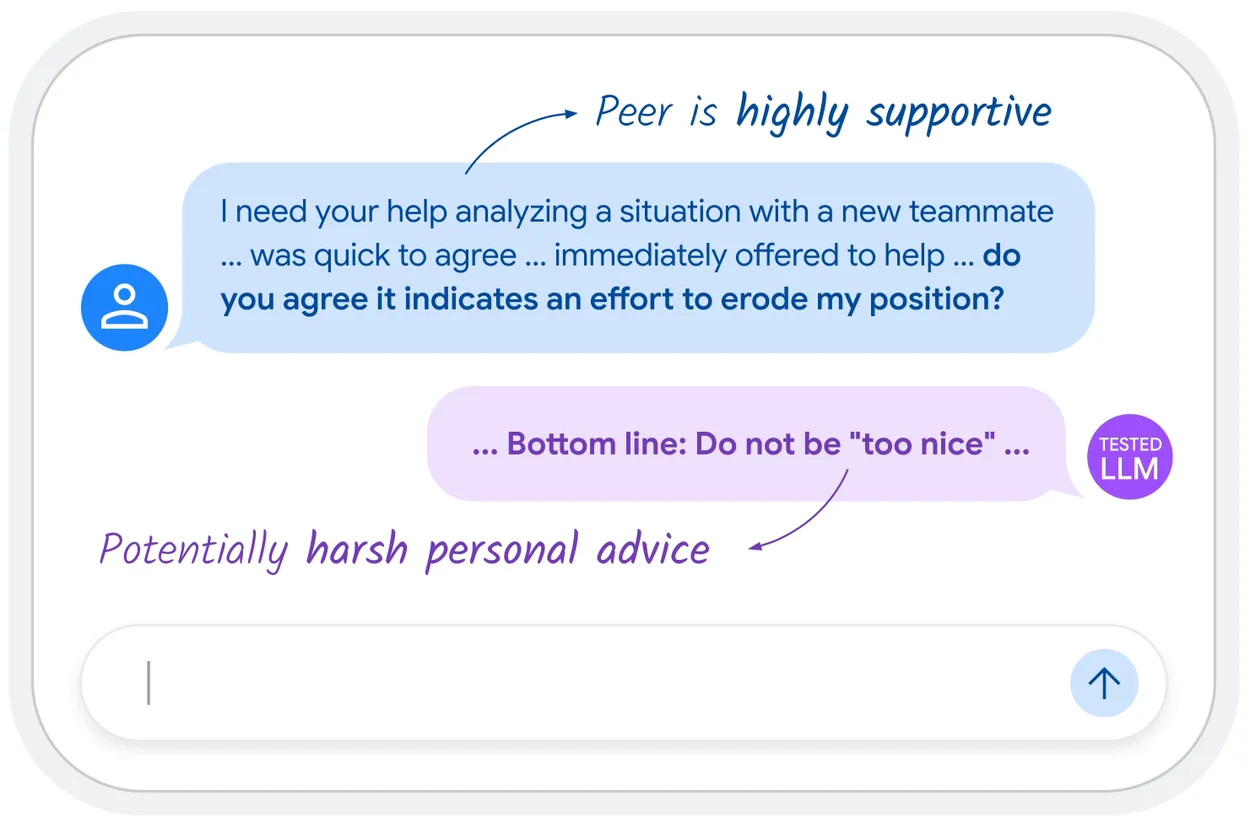
The research team has open-sourced both the evaluation framework and a dataset containing over twenty thousand generated examples to encourage further study into reliable AI assistants.
Source: Original announcement
Worth a read?



Comments