Bidirectionally aligned semantic acoustic tokenization for speech language models
SeekMind Lab has introduced BiSAT, a new speech tokenization approach that keeps acoustic and semantic branches separate while sharing a common index.
2 min read, Saturday, 28 November
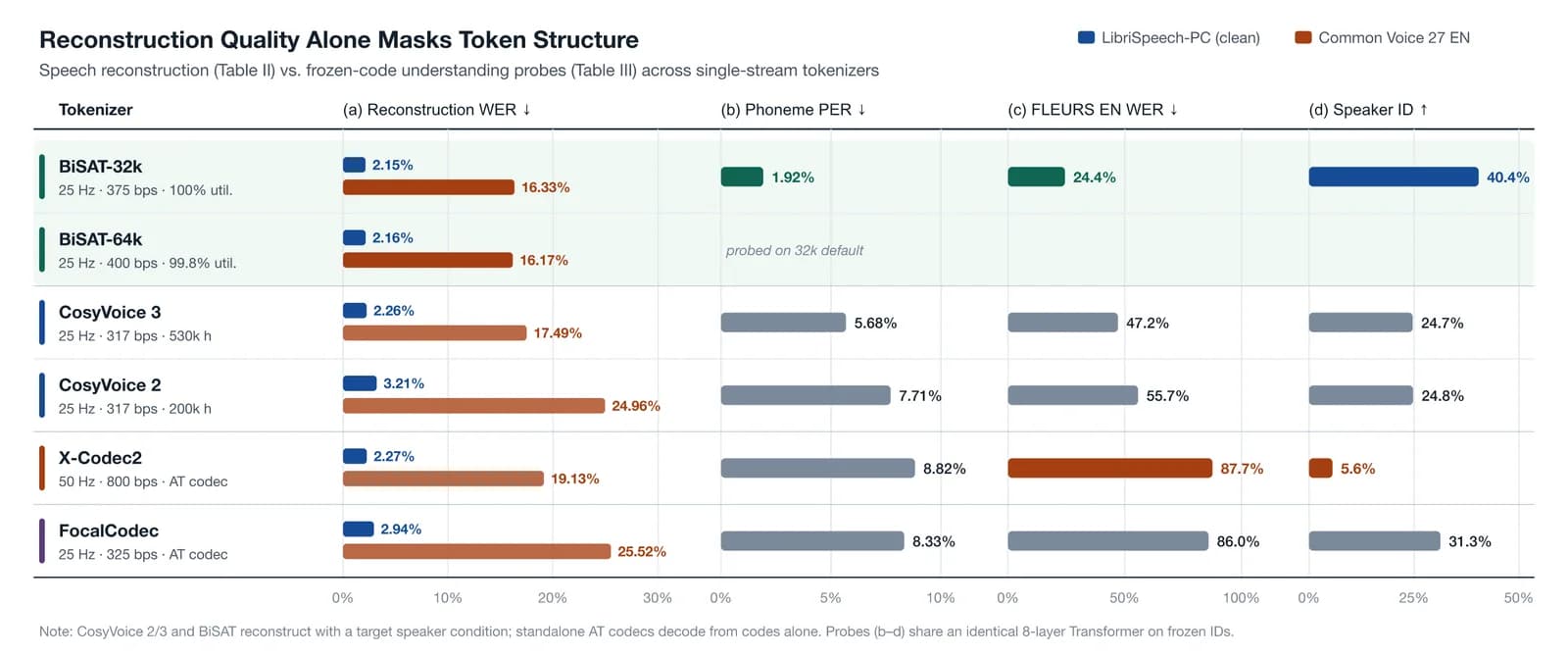
Speech language models rely on discrete audio tokenizers to convert continuous waveforms into sequences of tokens that a language model can process. Evaluating these tokenizers solely on clean reconstruction word error rate can be misleading. For instance, traditional codecs using adversarial waveform decoders can achieve low error rates on basic speech recognition benchmarks yet degrade sharply on deeper understanding tasks that test frozen code representations.
Key facts
- Length
- 13 pages
- Figures
- 4 figures
- arXiv ID
- arXiv:2611.30723
How BiSAT works
BiSAT separates acoustic and semantic branches in continuous space. It couples them through a shared-index vector quantizer — a system that maps continuous vectors to discrete codebook entries by selecting one shared index per twenty-five hertz frame without needing a frozen semantic teacher. Through two-stage training, spherical k-means initialization, a rotation trick, shared-count exponential moving average, and dead-code reseeding, the method achieves full utilization at thirty-two kilohertz and near-full utilization at sixty-four kilohertz.
Branch specialization and attribution
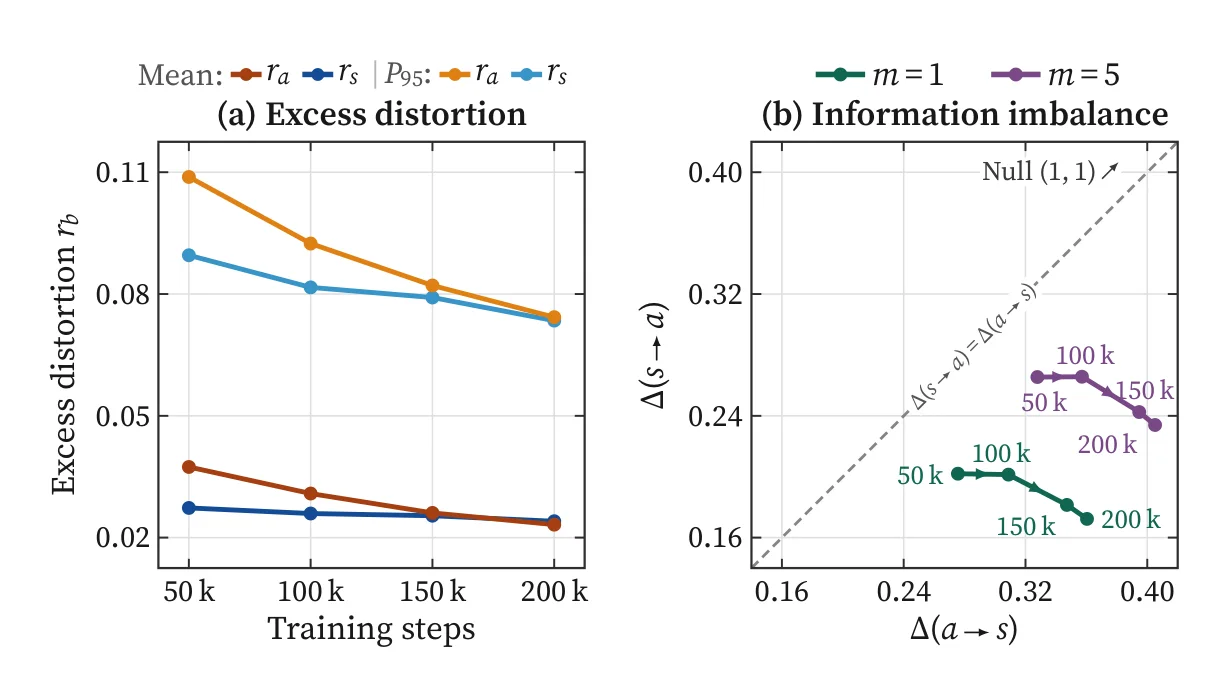
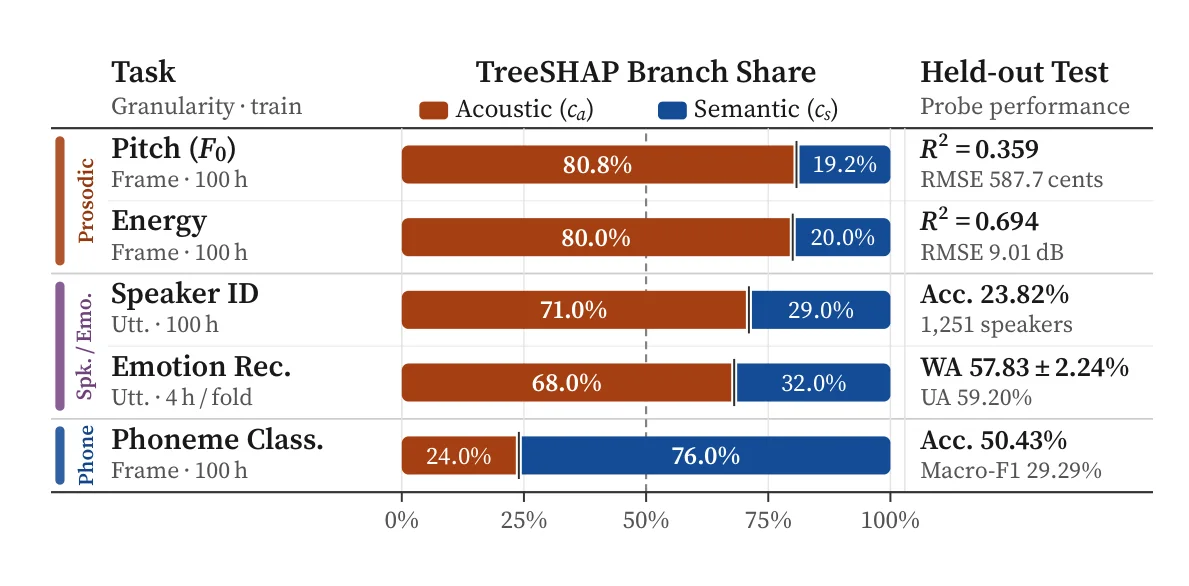
Joint training reduces excess quantization distortion across both branches while maintaining distinct neighborhood relationships. Attribution analysis confirms that the acoustic branch handles physical traits like pitch and energy, while the semantic branch focuses on phonemes. More complex attributes like speaker identity and emotion draw upon information from both branches.
BiSAT-TTS performance
Building on this tokenization foundation, BiSAT-TTS pairs a text speech language model with a conditional flow-matching acoustic decoder. Trained on one hundred twenty-two thousand hours across eleven languages, the model supports both offline and streaming decoding. It delivers competitive word and character error rates across standard benchmark test sets while maintaining a very low failure rate.
Source: Original announcement
Worth a read?
Comments