Weight-space programming does not need Transformers
Standard neural architectures like the Transformer were built for gradient descent, but weight-space programming lets large language models write network weights by hand.
2 min read, Thursday, 19 November
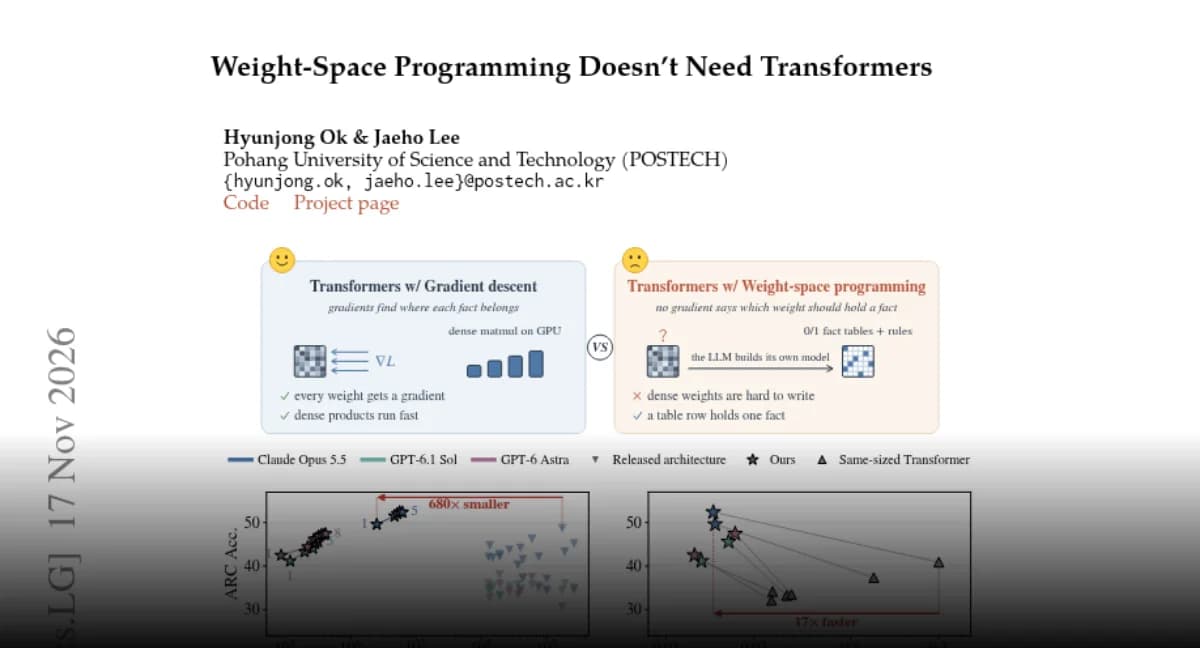
Standard neural network architectures, such as the Transformer, were originally chosen because they train well using gradient descent — an optimization algorithm that iteratively adjusts weights to minimize error — and run fast on graphics processing units. However, a new technique called weight-space programming changes these priorities. In this approach, a large language model writes target weights directly by hand without any gradient-based training, making traditional architecture constraints obsolete.
Researchers explored whether the Transformer remains the best choice for this paradigm. Given minimal guidance, ten labeled examples, and a testing sandbox, three frontier large language models were tasked with either generating the weights of a fixed architecture or designing a completely new architecture from scratch.
Key facts
- Test Accuracy
- up to 54.4%
- arXiv Identifier
- arXiv:2611.22055
Rethinking network design
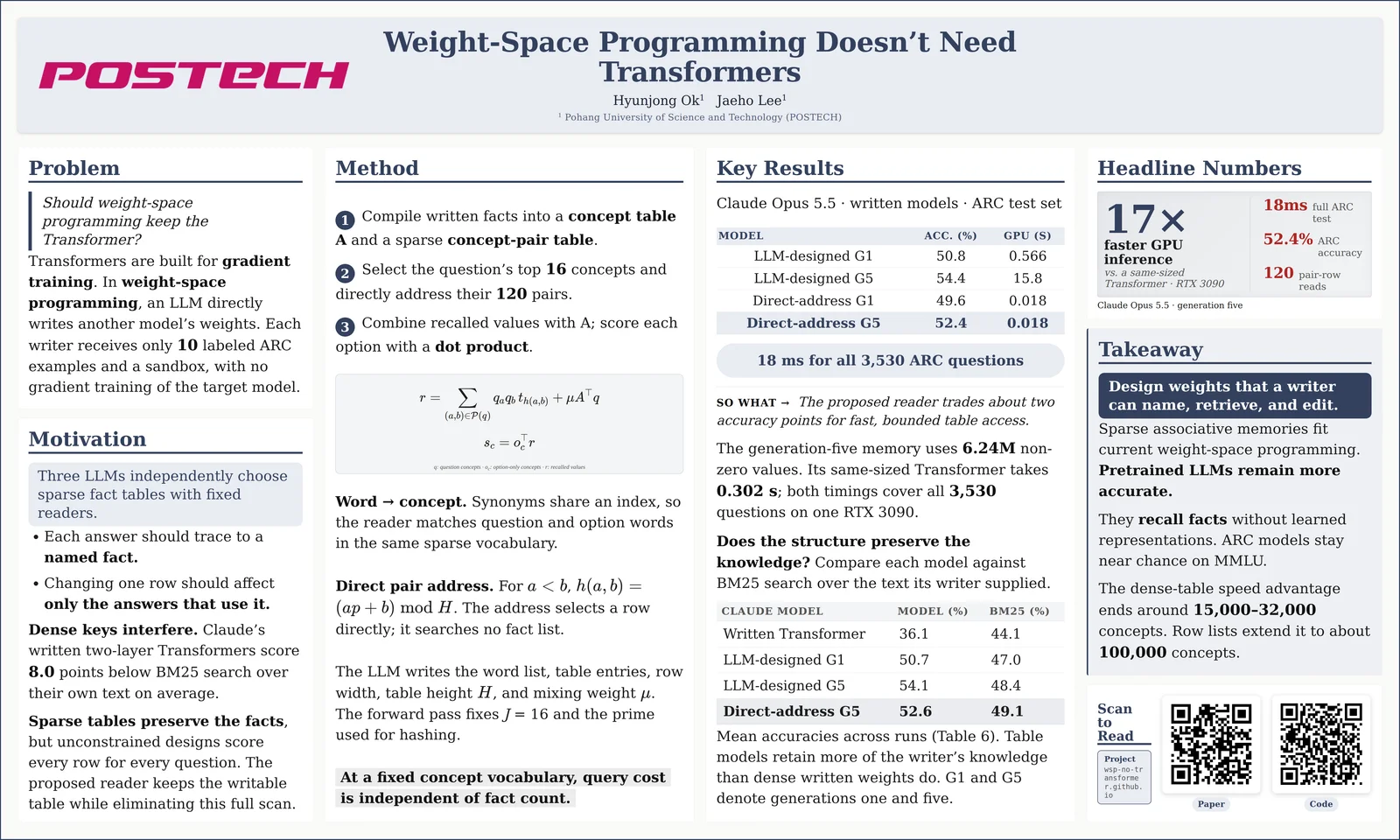
When given the freedom to design, all three tested models converged on a similar strategy. They compiled plain-text facts into a sparse table that is queried by a fixed procedure, reaching up to 54.4% test accuracy. This custom, language-model-designed model achieved higher test accuracy than the most accurate released Transformer written by the same model, while using about 1,800 times fewer parameters.
Without the requirement for gradients, the models opted for tabular structures where the large language model can explicitly state what each weight means. This transparency allows the system to easily find and rewrite incorrect weights. Each wrong answer points to a specific row in the table, and removing that row typically alters only one other answer.
Performance and speed
Based on these findings, researchers proposed an associative-memory-based model — a system that retrieves stored information by its content rather than its location. This new model is up to 17 times faster on graphics processing units than a Transformer of the same size. While pretrained large language models still remain more accurate overall, this research challenges assumptions about which structures to build when writing weights directly.
Source: Original announcement
Worth a read?


Comments