Posterior Matching Distillation improves few-step image generation
Diffusion distillation compresses iterative sampling processes to speed up image generation, but traditional methods often lose sample diversity.
2 min read, Sunday, 22 November

Diffusion distillation speeds up image and video generation by compressing a pretrained teacher model's slow, iterative sampling process into just a few network evaluations. Traditional distribution-based methods achieve this by forcing the student model's output distribution to match the teacher model. However, this matching process typically relies on reverse-KL objectives, which use a mode-seeking bias — a mathematical property that focuses on dominant modes of the data while ignoring rare variations — leading to a loss of diversity across generated samples.
Key facts
- Method
- Posterior Matching Distillation (PMD)
- Models tested
- SDXL and FLUX.2
- Model parameters
- 4B
- Sampling steps
- 4-step methods
- arXiv ID
- arXiv:2611.26629
- FID (4-step)
- SDXL: best among 4-step methods
- FLUX.2 4B: best among 4-step methods
- Prompt-alignment and perceptual-quality
- SDXL: competitive or leading
- FLUX.2 4B: competitive or leading
| Metric | SDXL | FLUX.2 4B |
|---|---|---|
| FID (4-step) | best among 4-step methods | best among 4-step methods |
| Prompt-alignment and perceptual-quality | competitive or leading | competitive or leading |
Introducing Posterior Matching Distillation
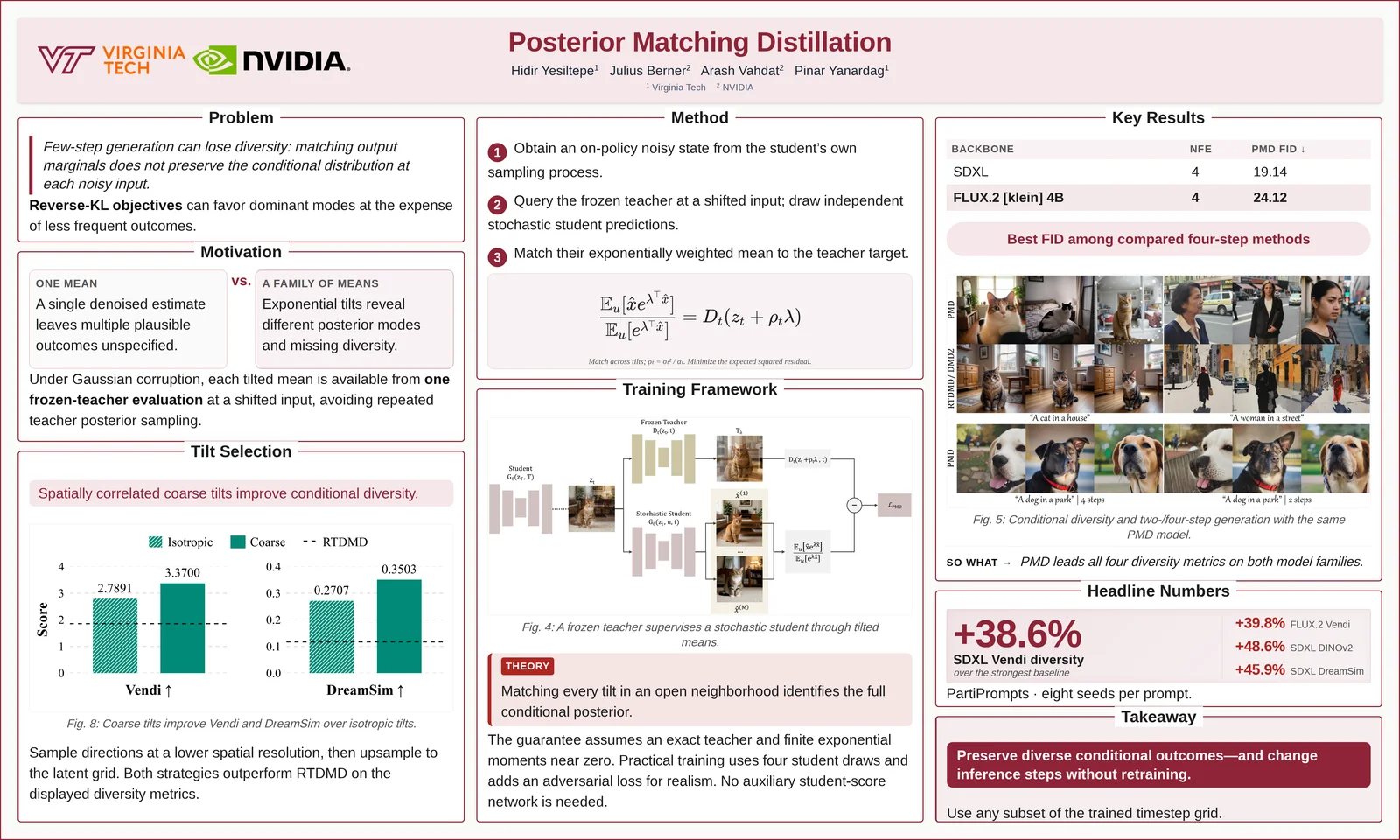
Posterior Matching Distillation, known as PMD, is a new approach within the distribution-based distillation family that combines mode-covering posterior sampling with any-step generation. At zero population loss, PMD recovers the teacher's full posterior of clean images — the probability distribution of original images given noisy inputs — at each trained noise level. Its stochastic student supports any-step sampling budgets within the trained timestep grid without requiring additional training.
To learn these posteriors, PMD matches exponentially reweighted averages of student samples conditioned on a fixed noisy state to corresponding teacher posterior means. Under Gaussian corruption, an exponentially tilted posterior mean corresponds to a single teacher evaluation at a shifted input. The research demonstrates that matching tilted means over an open neighborhood uniquely identifies the full posterior.
Results and Performance
PMD supervises the entire conditional distribution through a family of mean constraints, completely removing the need for any auxiliary student-score network. Experiments on SDXL and FLUX.2 4B demonstrate that PMD achieves the best Fréchet Inception Distance, a standard metric used to evaluate the quality of generated images, among four-step methods on both models. It also maintains competitive or leading performance across prompt-alignment and perceptual-quality metrics.
Source: Original announcement
Worth a read?



Comments