WAM-Policy brings language-guided loco-manipulation to quadrupeds
Arm-free quadruped robots can now follow language instructions to walk and manipulate objects simultaneously.
2 min read, Saturday, 21 November
Source page video
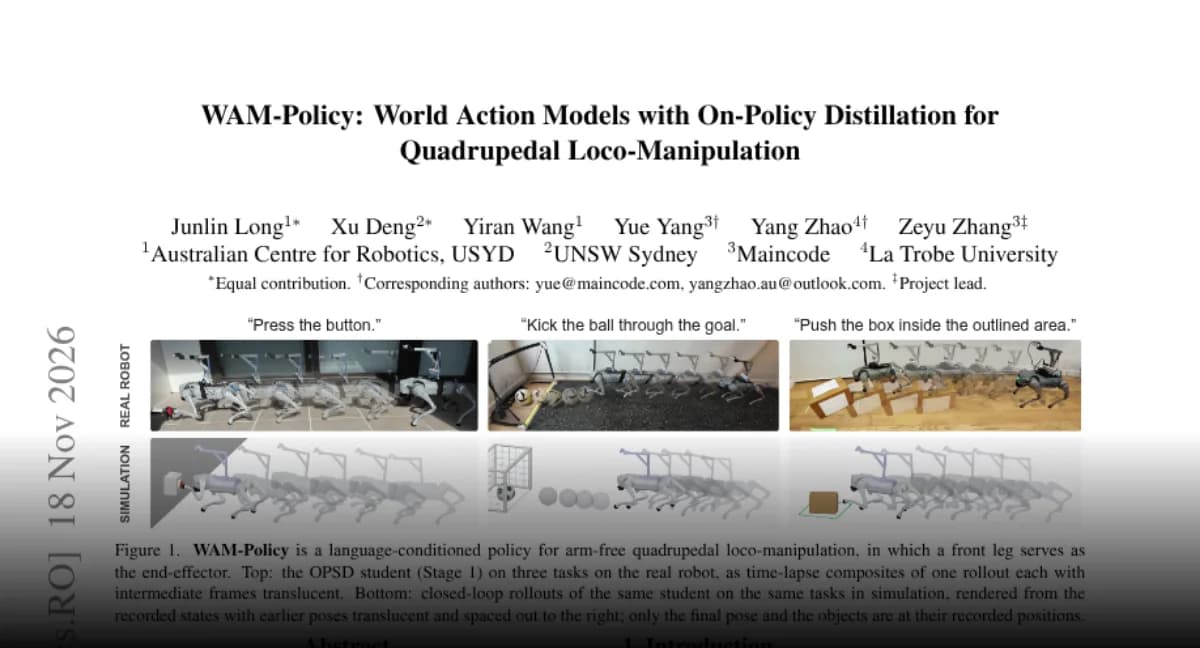
A quadruped robot executing language-guided loco-manipulation using WAM-Policy.
Quadruped robots without dedicated robotic arms can perform loco-manipulation, which means walking on three legs while using the remaining front leg to manipulate objects in their environment. Until now, however, no existing control policy for this capability could follow spoken or written language instructions. World action models — neural network policies that use video and language to predict robot movements — have emerged as effective language-conditioned tools, but they are typically pretrained for robotic arms and sample data far too slowly for real-time four-legged control.
To bridge this gap, researchers introduced WAM-Policy, a two-stage framework that transforms a standard world action model into a quadrupedal loco-manipulation policy. The first stage, cross-morphology policy adaptation and acceleration, adjusts the arm-centric model for four-legged hardware. It then uses on-policy self-distillation — a training technique where a smaller model learns to mimic a larger, more complex teacher model in real time — to compress the system into a student model requiring only one video frame and two action steps.
Key facts
- Benchmark
- QLM-Bench
- Hardware platform
- Unitree Go2 Air
- Initial policy success rate
- 77.0%
- OPSD student success rate
- 76.7%
- Improved policy success rate
- 85.0%
- arXiv ID
- arXiv:2611.24011
- Success rate
- Transferred policy: 77.0%
- OPSD student: 76.7%
- RL and M-OPD student: 85.0%
| Metric | Transferred policy | OPSD student | RL and M-OPD student |
|---|---|---|---|
| Success rate | 77.0% | 76.7% | 85.0% |
Training and performance
While the initial student model runs efficiently, it remains limited by its teacher, which only imitates pre-recorded demonstrations. To overcome this, the second stage applies task-specific reinforcement learning — a method where models learn by trial and error through reward signals — and merges multiple slow specialist models into a single fast student using multi-teacher on-policy distillation.
Testing on QLM-Bench, a simulation suite featuring ten tasks and one thousand demonstrations synthesized without manual teleoperation, showed clear performance gains. The direct transferred policy achieved a success rate of 77.0 percent, while the distilled student model retained a 76.7 percent success rate while operating fourteen times faster. Adding task-specific reinforcement learning and multi-teacher distillation lifted the final success rate to 85.0 percent.
Real-world deployment
The research team also deployed the distilled student model directly onto physical hardware using a Unitree Go2 Air robot. This demonstrates that advanced language-conditioned manipulation policies can be transferred from simulation to real quadrupedal hardware, reducing inference costs while expanding what four-legged robots can achieve in unstructured environments.
Source: Original announcement
Worth a read?

Comments