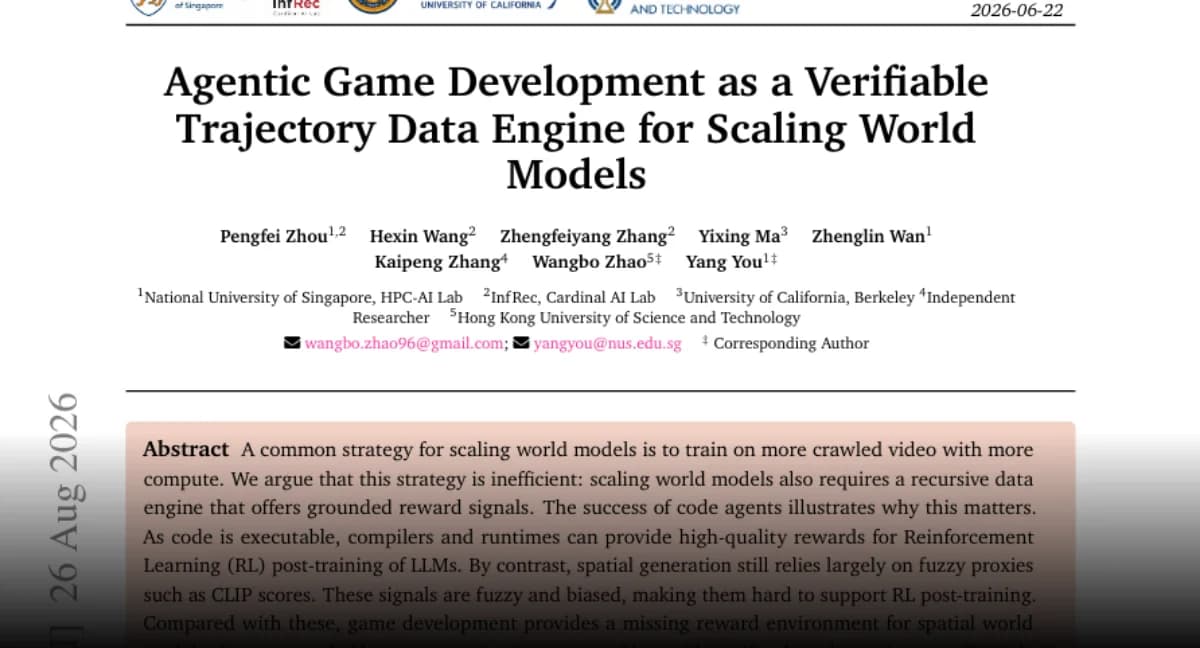
Using agentic game development to scale spatial world models
Training spatial world models purely on internet video is inefficient because it lacks precise reward signals. Researchers propose using game engines and agentic development workflows to generate verifiable, long-horizon training data.
Published by Jin · 2 min read · 30 AUG 2026
Training large artificial intelligence models usually relies on gathering more crawled video data and throwing more compute power at the problem. A group of researchers argues that this approach is inefficient. Just as language models advanced rapidly because code execution environments provide concrete rewards, spatial world models need a similar foundation to move past blurry, biased metrics.
The limits of current spatial training
When training models that generate visual or spatial environments, developers often rely on fuzzy metrics like CLIP scores to measure quality. These alignment scores evaluate how well an image matches a text description, but they remain prone to bias and lack precision. Without exact feedback, it becomes very difficult to run reinforcement learning post-training — a process where a model refines its behavior through trial and error based on clear rewards.
Coding models succeed because computer code is executable. Compilers and software runtimes immediately tell an agent whether its code works or fails. Spatial generation currently lacks an equivalent environment that can offer clear, automated feedback for spatial reasoning.
Game engines as verification engines
To solve this, researchers point to video game development as a natural reward environment for spatial world models. A virtual scene created inside a game engine serves as an executable world specification.
Game engines can automatically and efficiently check several critical factors:
- Collision detection
- Physics interactions
- Map navigability
- Bounded playability
While the engine handles these hard mathematical checks, human developers provide a global verification signal by deciding whether a generated scene meets their artistic and functional goals.
A new training paradigm
Based on this dynamic, the team introduces Reinforcement Learning with Human-Engine Verification. This post-training paradigm combines dense, automated checks from game engines with the implicit acceptance feedback of human developers working through the development process.
By treating agentic game creation as a data engine, artificial intelligence systems can generate long-horizon trajectory data rooted in real-world simulation rules. This structured approach aims to help spatial world models scale more reliably.
Source — Original announcement ↗
Worth a read?
Comments · 0