A sleep framework for continuous learning in large language models
Researchers at Google have introduced a sleep framework for large language models that mimics human rest to consolidate short-term memories into stable long-term parameters.
3 min read·Wednesday, 28 October
Conceptual illustration of abstract shapes consolidating into an interconnected neural network sphere.
Large language models are traditionally static after training, operating with a fixed knowledge cutoff date that prevents them from acquiring long-term capabilities over time. Updating models directly with new data often causes catastrophic forgetting, a fundamental issue where learning new tasks severely degrades performance on previously learned ones. Alternatively, relying strictly on in-context learning keeps knowledge trapped in the immediate session window, where it is lost once the session ends.
To address this limitation, researchers have introduced a sleep framework inspired by how the human brain stabilizes memory during rest. This paradigm equips models with a periodic lifecycle that alternates between active interaction and offline memory consolidation.
Connectionist networks: Sensitive to new information
Ability to generalize
Lookup tables: Lacks the ability to generalize
Connectionist networks: Can generalize to unseen inputs
Metric
Lookup tables
Connectionist networks
Stability in presence of new information
Remains completely stable
Sensitive to new information
Ability to generalize
Lacks the ability to generalize
Can generalize to unseen inputs
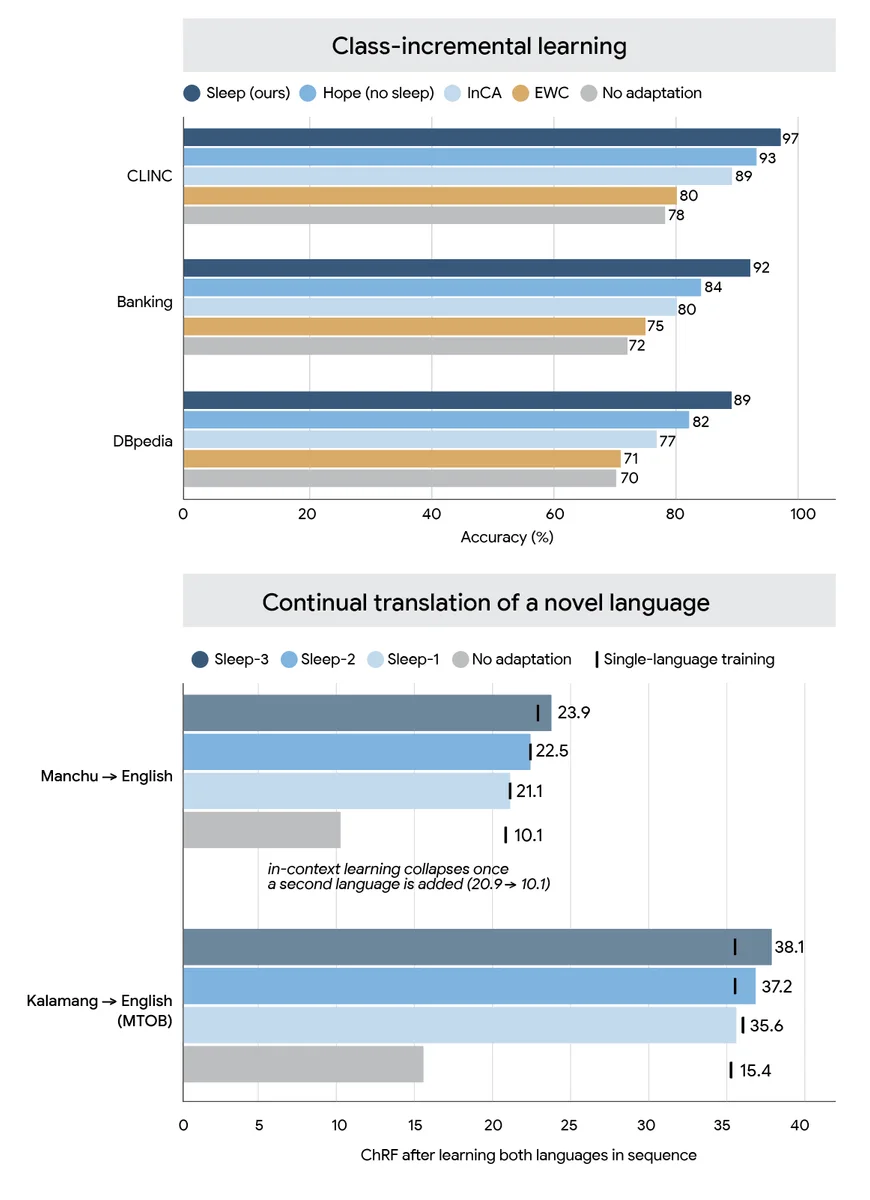
Performance evaluation comparing sleep frameworks against baselines on class-incremental learning and continual translation. · Source ↗
Active and sleep phases
Under the sleep framework, a model operates across two distinct states.
Active (wake) phase: The model receives and interacts with inputs, temporarily storing information in fast short-term memory components.
Sleep phase: The model pauses external input processing to direct its computations toward memory consolidation and self-improvement.
During the offline sleep phase, the model unlocks pre-allocated mixture-of-experts memory blocks — architecture configurations where the network routes tokens to specialized sub-networks — and updates its numerical weights using self-generated practice examples.
Memory consolidation and dreaming
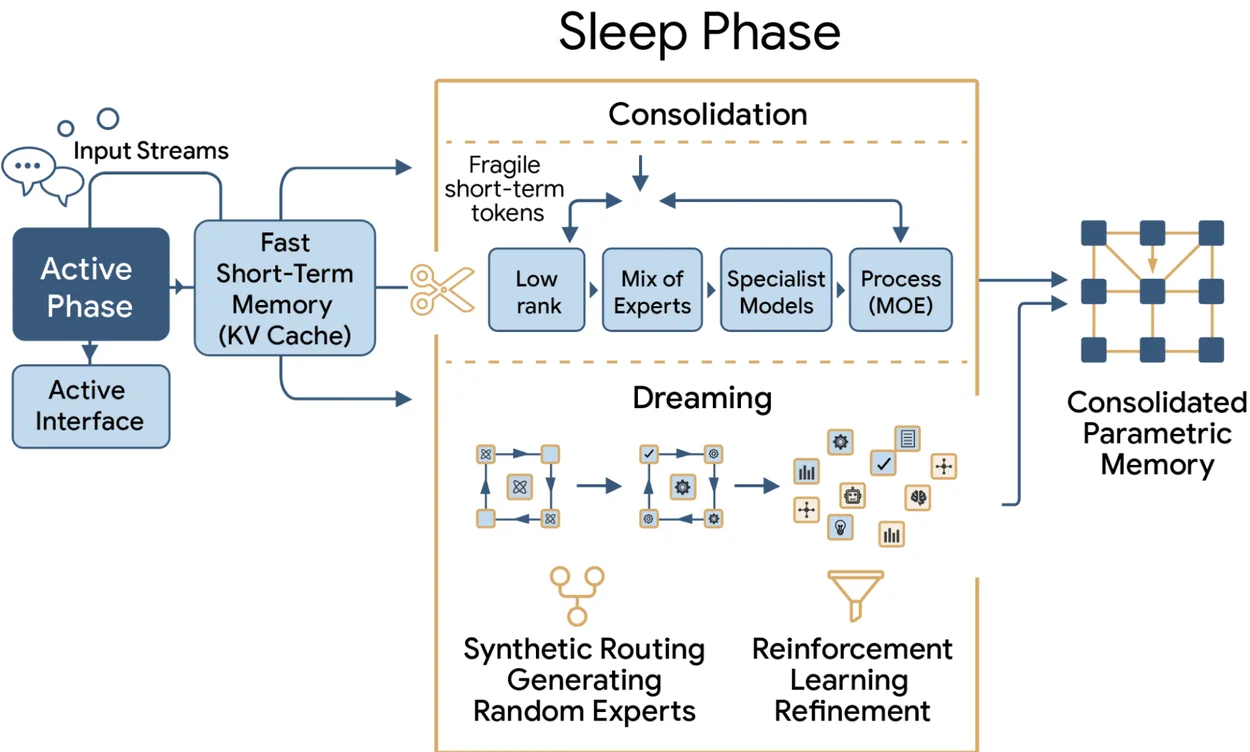
The sleep process unfolds through two primary stages. First, memory consolidation transfers fragile short-term memories into expanded long-term parameters. The framework uses a mixture of experts and hope architecture to integrate low-rank experts — compressed parameter matrices that reduce computational overhead — into stable memory blocks without disrupting older parameters. Fragile memories are distilled into these expanded parameters using generalized knowledge distillation and reinforcement learning.
Flowchart depicting the active and sleep phases, showing how short-term memory is consolidated into parametric memory. · Source ↗
Second, a dreaming stage drives autonomous self-improvement. During this phase, the model randomly selects non-standard experts to mix disparate domains of knowledge, generates synthetic training samples, and applies gradient-based filtering to select the most effective learning experiences.
Performance across evaluations
In empirical testing, the sleep framework demonstrated significant improvements over standard baseline methods across several capability axes.
Continual translation: Maintained near-zero performance drop in unseen languages like Manchu and Kalamang, avoiding the severe forgetting seen in supervised fine-tuning and in-context learning.
Long-context scaling: Scaled near-perfectly up to ten million tokens on the BABILong benchmark, outperforming models such as GPT-4 and Titans.
Factual incorporation: Achieved 48.9% on single-task and 46.2% on continued pre-training evaluations on SQuAD.
Mathematical reasoning: Reached accuracy scores of 79.2%, 69.0%, and 46.1% on AIME 24, AIME 25, and HMMT 25 benchmarks.
The Ultimate 2026 Free AI API Engine: Top 10 Provider Blueprints & Setup GuideFree guide




Comments