Unifying image generation control with diffusion controller
Steering text-to-image models to follow precise prompts without losing visual quality has long been a balancing act.
2 min read, Wednesday, 30 September
Text-to-image models let users create photorealistic pictures from text descriptions. However, guiding these massive systems to follow complex instructions—such as adding specific items without distorting the main subject—is difficult. Existing methods like prompt adjustments and parameter adapters are often disconnected, forcing developers to rely on trial and error.
Key facts
- Paper title
- Diffusion Controller: Framework, Algorithms and Parameterization
- Authors
- Tong Yang and 6 other authors
- Base model
- Stable Diffusion v1.4
The Diffusion Controller Framework
To solve this, researchers introduced Diffusion Controller, a framework that reframes image generation as a smooth, continuous control problem. The core idea relies on a lightweight add-on network that acts like a steering damper on a motorcycle. Instead of rebuilding the main engine, the damper attaches to the base pre-trained model while keeping the main model completely frozen.
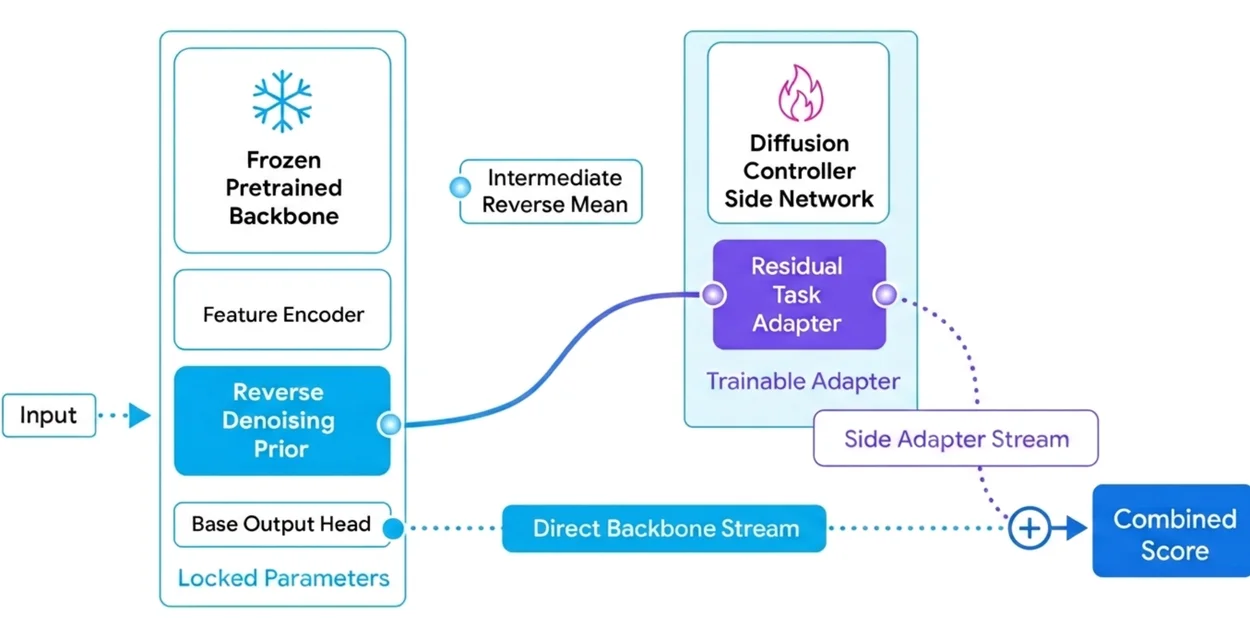
This steering damper dynamically adjusts the generation trajectory as an image is created from random noise. It applies microscopic corrections to favor user-defined targets, such as artistic style or contextual alignment, while preventing visual distortions.
Practical Training Methods
To bridge the gap between abstract equations and practical application, the framework introduces two fine-tuning methods based on reward scores:
- Policy gradient and PPO: An iterative approach with a built-in speed limiter to prevent erratic changes and ensure stable training.
- Reward-weighted loss: A direct optimization path that rewards high-quality generation processes to reliably teach the model.
Experiments and Results
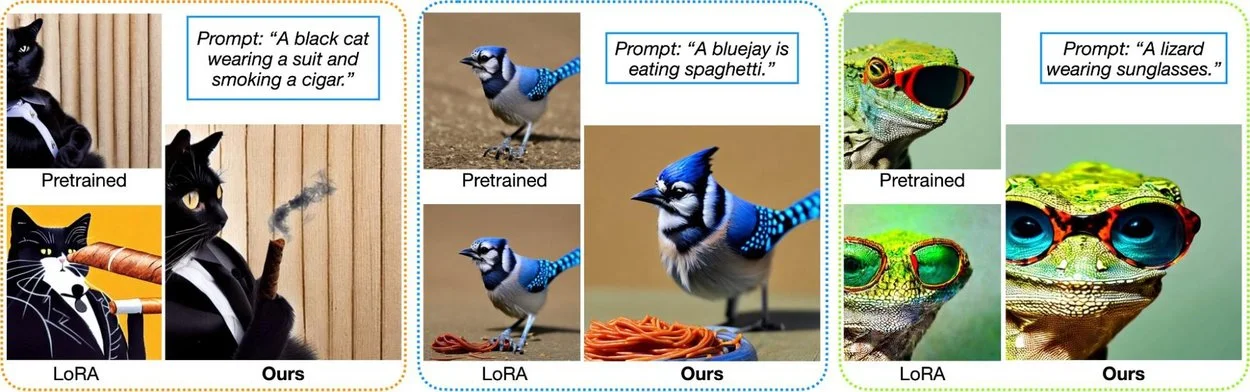
Evaluated using a Stable Diffusion v1.4 backbone, the framework excelled in both white-box environments with full model access and restrictive gray-box environments. In supervised fine-tuning and reward-weighted loss tracks, the gray-box steering damper outperformed LoRA—a popular parameter-efficient approach—in win rates while manipulating fewer internal layers. Furthermore, a fully unlocked white-box version achieved a 90% win rate over the baseline model.
At runtime, users can adjust a single guidance strength parameter to dynamically change the intensity of control constraints without causing visual distortions. This unified approach opens new paths for advanced personalization, safety mechanisms, and control of next-generation video models.
Source: Original announcement
Worth a read?



Comments