TimesFM-3 model for multivariate time series forecasting
TimesFM-3 is a new time series foundation model designed to natively handle multivariate data. It processes complex relationships across multiple variables in a single pass.
2 min read·Tuesday, 1 September
Google Research has introduced TimesFM-3, a state-of-the-art time series foundation model that enables accurate multivariate forecasting in a single forward pass.
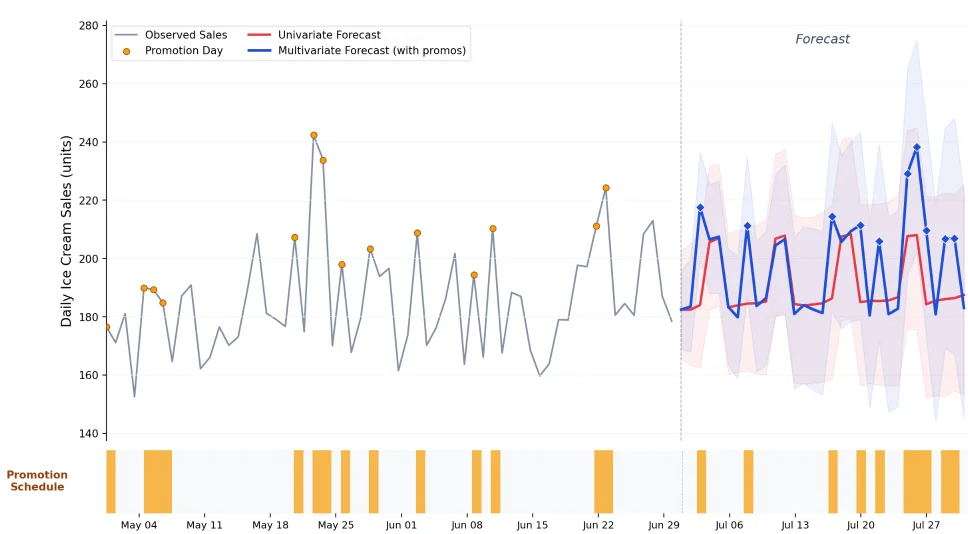
Comparison of univariate and multivariate sales forecasts incorporating promotion schedule covariates. · Source ↗
Moving beyond univariate forecasting
Previous versions of the model, up to TimesFM-2.5 released in September 2025, were strictly limited to univariate forecasting. This meant they could only use the history of a single time series to predict the future. However, most real-world scenarios are multivariate, where multiple time series and auxiliary external features jointly impact future outcomes.
For example, predicting retail ice cream sales is more accurate when drawing on sales of related products, historical foot traffic, and known future events like weather forecasts and promotions.
Architecture and inference
TimesFM-3 features 330 million parameters and is pre-trained on a corpus comprising more than 1 trillion time points. The model builds on a decoder-only transformer architecture — a neural network design that processes data sequentially using attention mechanisms.
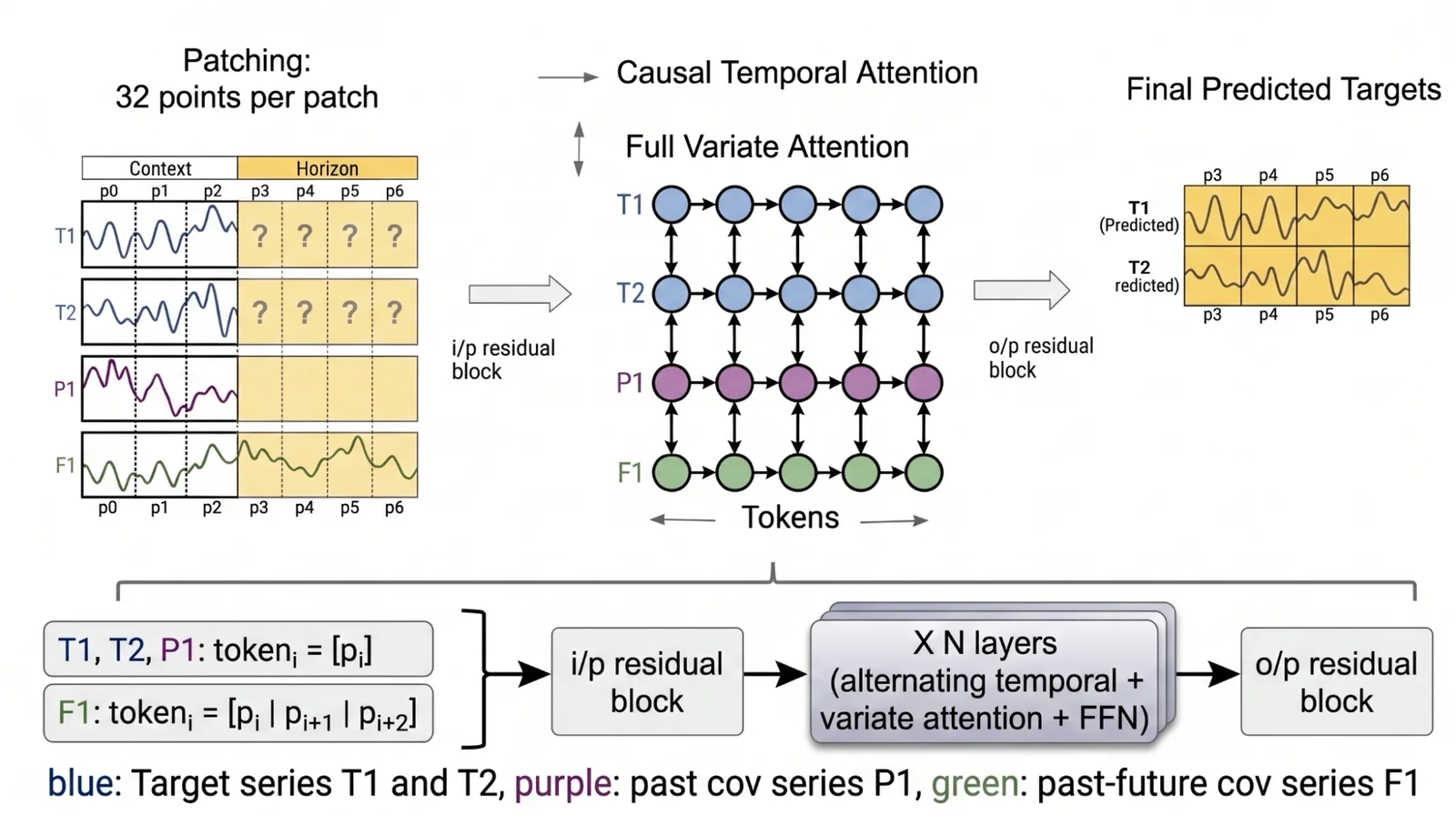
Architecture diagram detailing TimesFM-3 data patching, causal temporal attention, and full variate attention mechanisms. · Source ↗
Data points are grouped into patches of 32 time steps. The model then uses an alternating attention architecture consisting of:
Causal temporal attention: Tokens attend horizontally across time within their own specific time series.
Full variate attention: Tokens attend vertically across all other series at any given time step to learn cross-series correlations.
Single-pass generation
Instead of generating forecasts one patch at a time, TimesFM-3 uses contiguous patch masking to generate the entire forecasting horizon in a single forward pass. The model predicts 9 quantiles, ranging from the 10th to the 90th percentile, for each target time series at every horizon step.
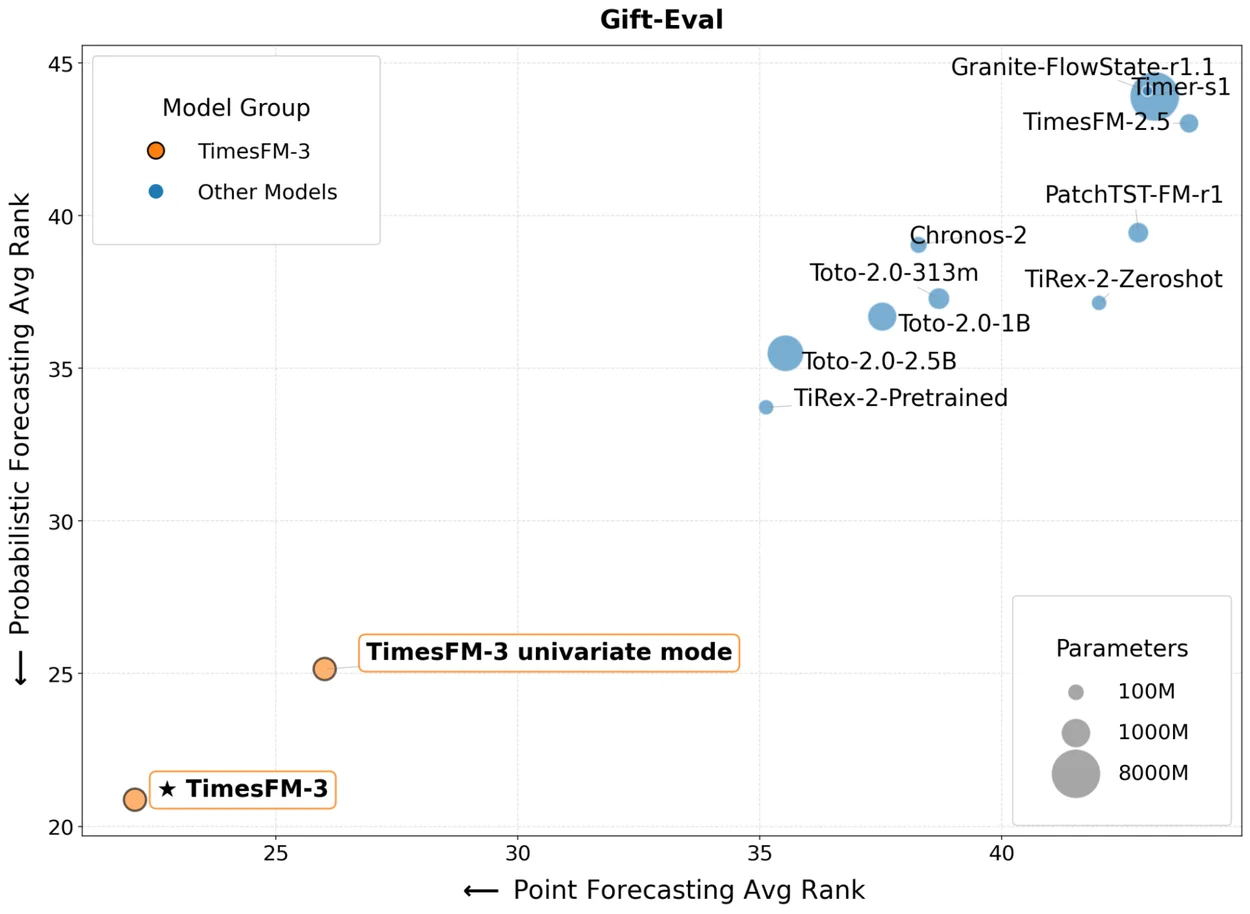
Evaluated on public benchmarks including Gift-Eval, FEV-Bench, and Time, TimesFM-3 ranks as a top-performing pre-trained foundation model for both point and probabilistic forecasting metrics.
Benchmark evaluation chart comparing TimesFM-3 against leading forecasting models on GIFT-Eval. · Source ↗
The Ultimate 2026 Free AI API Engine: Top 10 Provider Blueprints & Setup GuideFree guide




Comments