Tencent Releases Hunyuan3D Buffalo 1.0 for 3D Generation and Editing
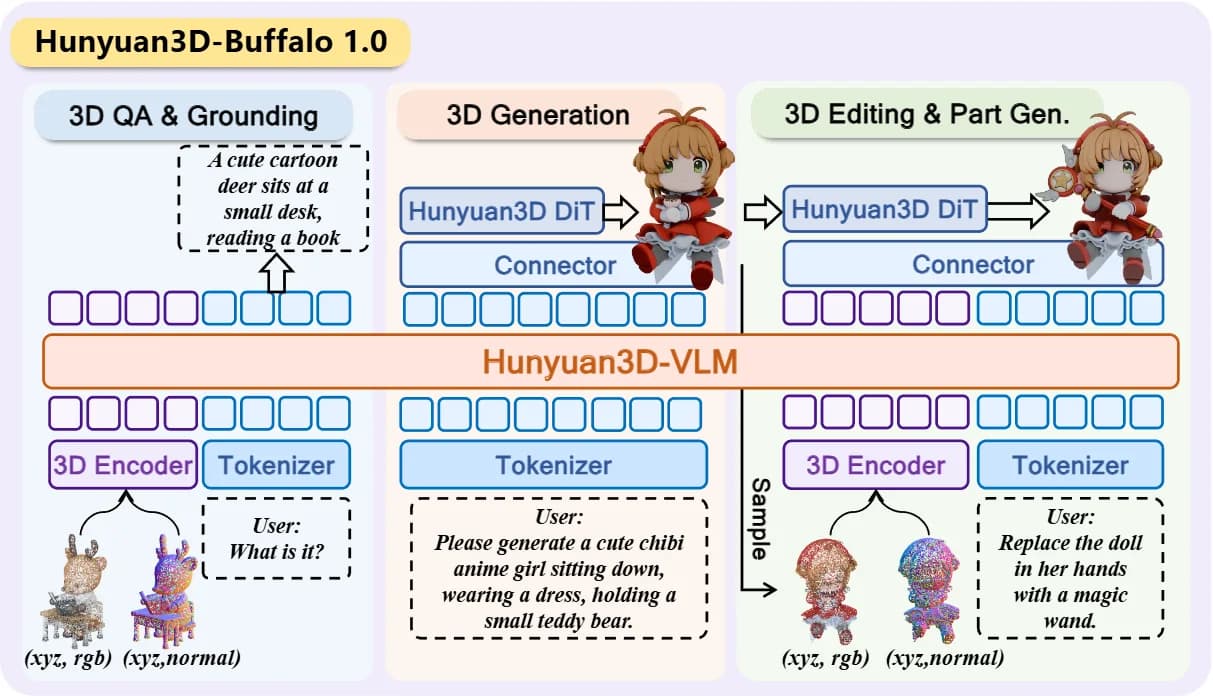
Tencent has reported the release of Hunyuan3D Buffalo 1.0, a unified multimodal framework designed for 3D generation, understanding, and editing. According to project documentation, the system integrates language comprehension with generative modules to handle tasks ranging from text-to-3D creation to instruction-guided mesh modifications.
Published by Jin · 2 min read · 9 AUG 2026
- Tencent
- Hunyuan3D-Buffalo 1.0
- Hunyuan3D-VLM and Hunyuan3D DiT modules
- 3D understanding, text-to-3D, instruction-guided editing, part generation
Tencent has reported the release of Hunyuan3D Buffalo 1.0, a new unified multimodal framework built for 3D generation, understanding, and editing. Traditional artificial intelligence tools for three-dimensional modeling typically focus entirely on single-shot generation—meaning a user inputs a prompt and receives a static digital object that is difficult to change afterward. Hunyuan3D Buffalo 1.0 aims to address this limitation by combining language understanding with generative 3D modules into a single pipeline.
Core Architecture and Pipeline
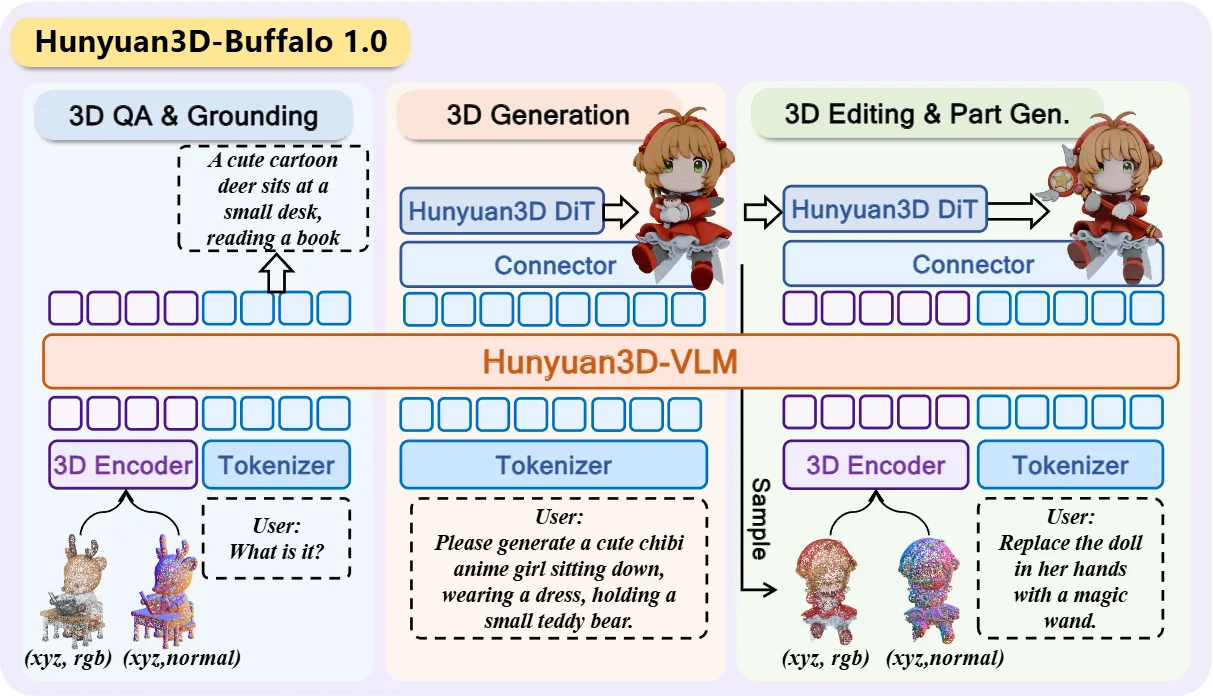
According to official project materials from Tencent, the framework relies on a shared visual-language backbone known as Hunyuan3D-VLM. This component acts as a bridge between text and spatial data, allowing the system to process three-dimensional question answering, spatial grounding, and part-level decomposition. Building upon this unified representation, Hunyuan3D Diffusion Transformer (DiT) modules—where a diffusion transformer is a neural network architecture that generates data by iteratively removing noise across spatial patches—enable scalable multimodal generation and high-quality editing.
Multimodal Capabilities
The framework supports several distinct workflows within its pipeline. For text-to-3D creation, users can generate assets directly from descriptive text prompts. For spatial understanding, the system performs question answering and grounding guided by natural language. Additionally, the framework supports instruction-guided editing, enabling users to modify existing digital meshes using text instructions while preserving surrounding geometry. It also includes part-extraction features that isolate and visualize individual components of a whole mesh either combined or separated into exploded views.
Source — tencent-hunyuan.github.io ↗
Worth a read?
Comments · 0