ScaleVLA: scaling vision-language-action models to 552 billion parameters
Researchers introduce ScaleVLA, connecting a massive 552 billion parameter vision-language model backbone to a trainable action generator.
2 min read, Wednesday, 18 November
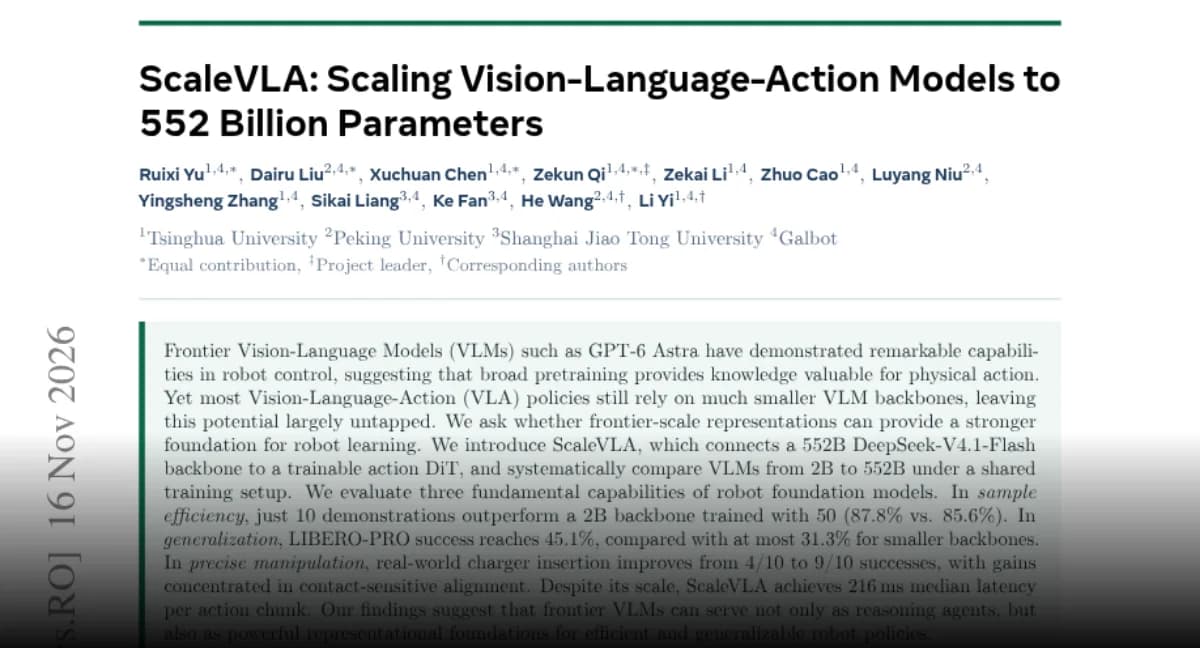
Most vision-language-action policies, which are systems that allow robots to interpret visual data and execute physical movements, rely on relatively small backbone models. A new research project explores whether scaling these foundational models up to frontier sizes can provide a much stronger base for robot learning.
Key facts
- Model Name
- ScaleVLA
- Backbone Model
- 552B DeepSeek-V4.1-Flash
- Action Decoder
- trainable action DiT
- Action Chunk Latency
- 216 ms median per action chunk
- Authors
- Ruixi Yu and 11 other authors
- Sample efficiency (10 vs 50 demonstrations)
- ScaleVLA (552B Backbone): 87.8% (10 demos)
- Smaller Backbones (2B Backbone): 85.6% (50 demos)
- LIBERO-PRO success
- ScaleVLA (552B Backbone): 45.1%
- Smaller Backbones (2B Backbone): at most 31.3%
- Real-world charger insertion
- ScaleVLA (552B Backbone): 9/10 successes
- Smaller Backbones (2B Backbone): 4/10 successes
| Metric | ScaleVLA (552B Backbone) | Smaller Backbones (2B Backbone) |
|---|---|---|
| Sample efficiency (10 vs 50 demonstrations) | 87.8% (10 demos) | 85.6% (50 demos) |
| LIBERO-PRO success | 45.1% | at most 31.3% |
| Real-world charger insertion | 9/10 successes | 4/10 successes |
Introducing ScaleVLA
The researchers developed ScaleVLA by linking a 552 billion parameter DeepSeek-V4.1-Flash model to a trainable action DiT, which is a diffusion transformer model that generates coordinated physical movements. By testing models ranging from 2 billion to 552 billion parameters under identical training conditions, the team evaluated how model scale impacts core robotic capabilities.
Performance and Generalization
The experiments highlight major improvements across three key areas:
- Sample efficiency: Just 10 training demonstrations allowed the large model to outperform a 2 billion parameter backbone trained on 50 demonstrations, scoring 87.8% compared to 85.6%.
- Generalization: Success rates on the LIBERO-PRO benchmark reached 45.1%, whereas smaller backbones maxed out at 31.3%.
- Precise manipulation: In real-world charger insertion tasks, success rates jumped from 4 out of 10 attempts to 9 out of 10, particularly benefiting contact-sensitive alignment.
Despite running on a massive underlying model, ScaleVLA achieves a median latency of 216 milliseconds per action chunk, showing that frontier models can serve as practical foundations for physical robot control.
Source: Original announcement
Worth a read?

Comments