Reason over time-series data with OpenTSLM on Amazon SageMaker JumpStart
OpenTSLM, a new family of time-series language models developed by Aionic Labs, is now available for deployment on Amazon SageMaker JumpStart.
2 min read, Wednesday, 18 November
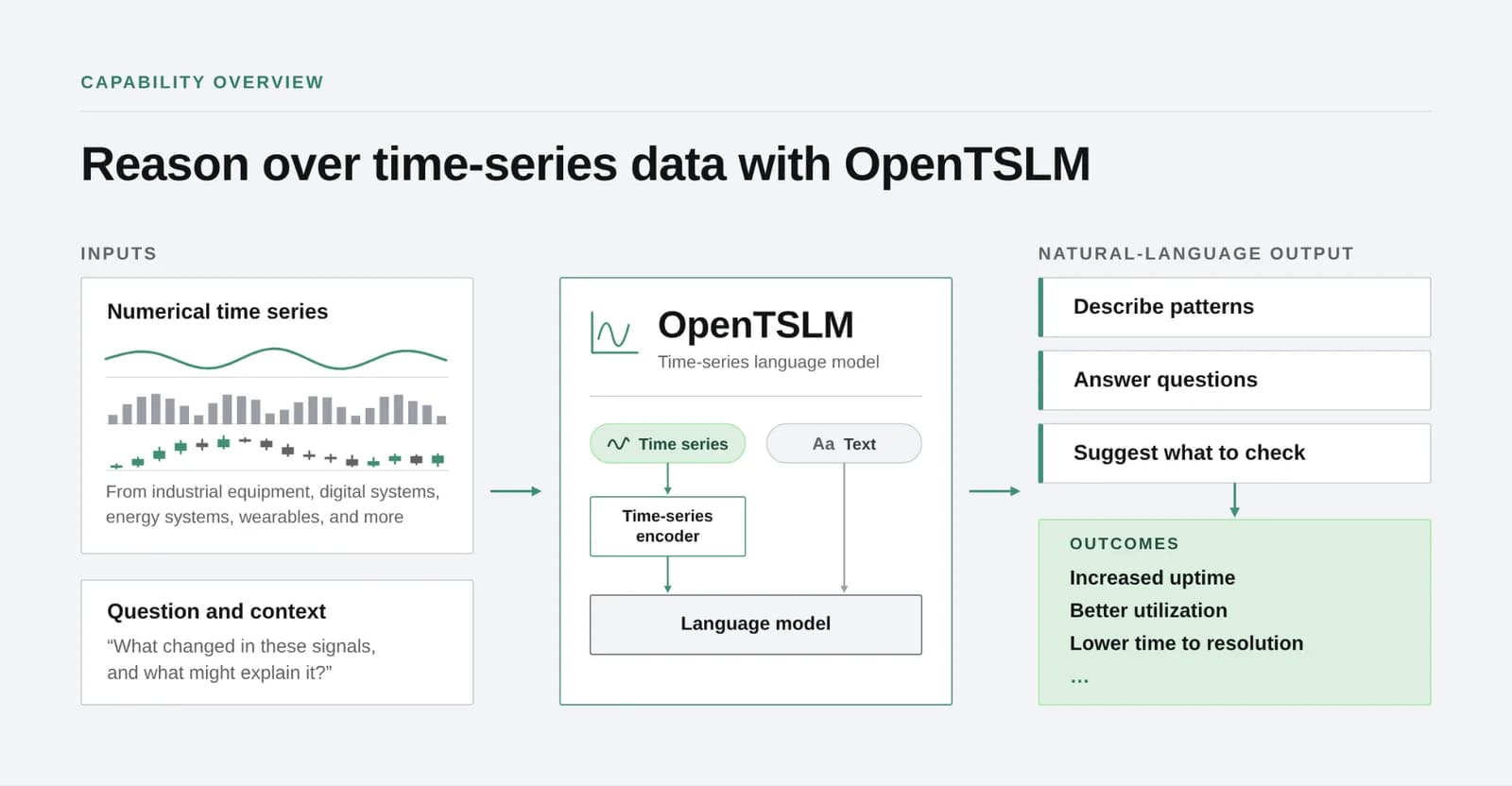
Industrial and digital operations generate vast amounts of numerical measurements, from equipment sensor data to device telemetry. Interpreting this data often requires specialized manual time, and general-purpose language models can become expensive when processing long histories across hundreds of metrics as text or images. To address this, Aionic Labs developed OpenTSLM, an open-source family of time-series language models designed to interpret operational measurements alongside text context such as maintenance records and engineering observations.
Key facts
- Total parameters
- 5.24 billion
- Weight format
- bfloat16
- GPU memory required
- 10.5 GB
- Default instance type
- ml.g6.2xlarge
Understanding time-series language models
Time-series language models, or TSLMs, connect numerical measurements with text to help systems recognize emerging problems in recent data. Experts can then ask follow-up questions to understand what changed and decide how to respond. TimeNet serves as the shared data infrastructure, providing a unified format and application programming interface, commonly known as an API, to find, build, and load datasets for training and evaluating these models.
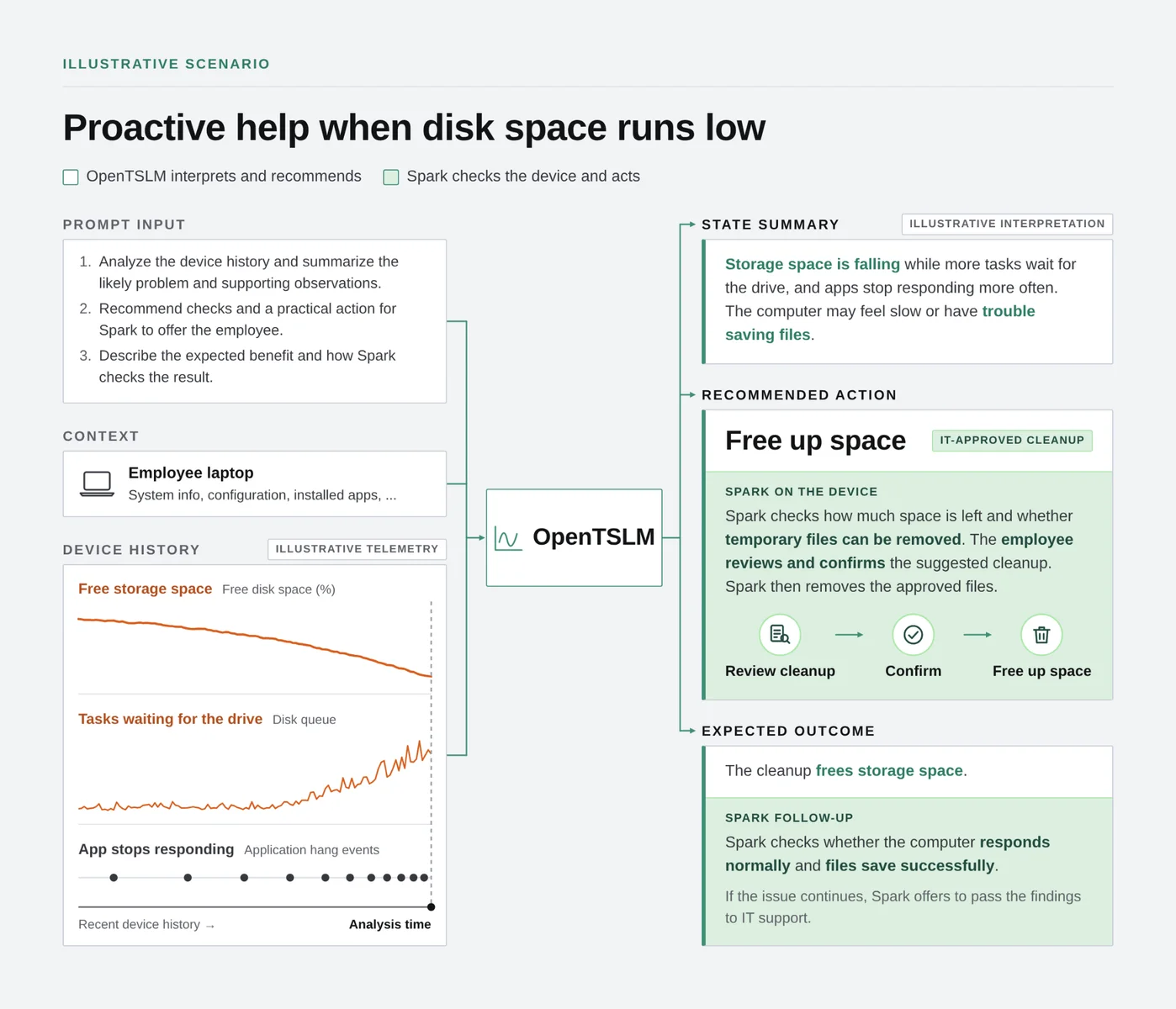
A practical example of this approach appears in proactive information technology support. Nexthink integrates OpenTSLM into its personal IT agent, Spark, to connect device telemetry such as central processing unit activity, memory use, and application stability with timestamped event context. When a device experiences slow performance or application crashes, the model generates a state summary explaining the likely issue, a recommended action for verification or cleanup, and an expected outcome.
Deployment via Amazon SageMaker JumpStart
The specific model available in Amazon SageMaker JumpStart is OpenTSLM-Flamingo. It combines the Gemma 3 4B language model with a time-series encoder and cross-attention layers that allow the language model to attend to the encoded series. The model contains 5.24 billion parameters stored in bfloat16 format, requiring approximately 10.5 gigabytes of graphics processing unit memory.
Amazon SageMaker JumpStart is a machine learning model hub that provides pre-built inference containers with graphics processing unit acceleration, automatic scaling endpoints, and enterprise security features. Developers can deploy OpenTSLM using either the SageMaker Studio graphical interface or the SageMaker Python software development kit.
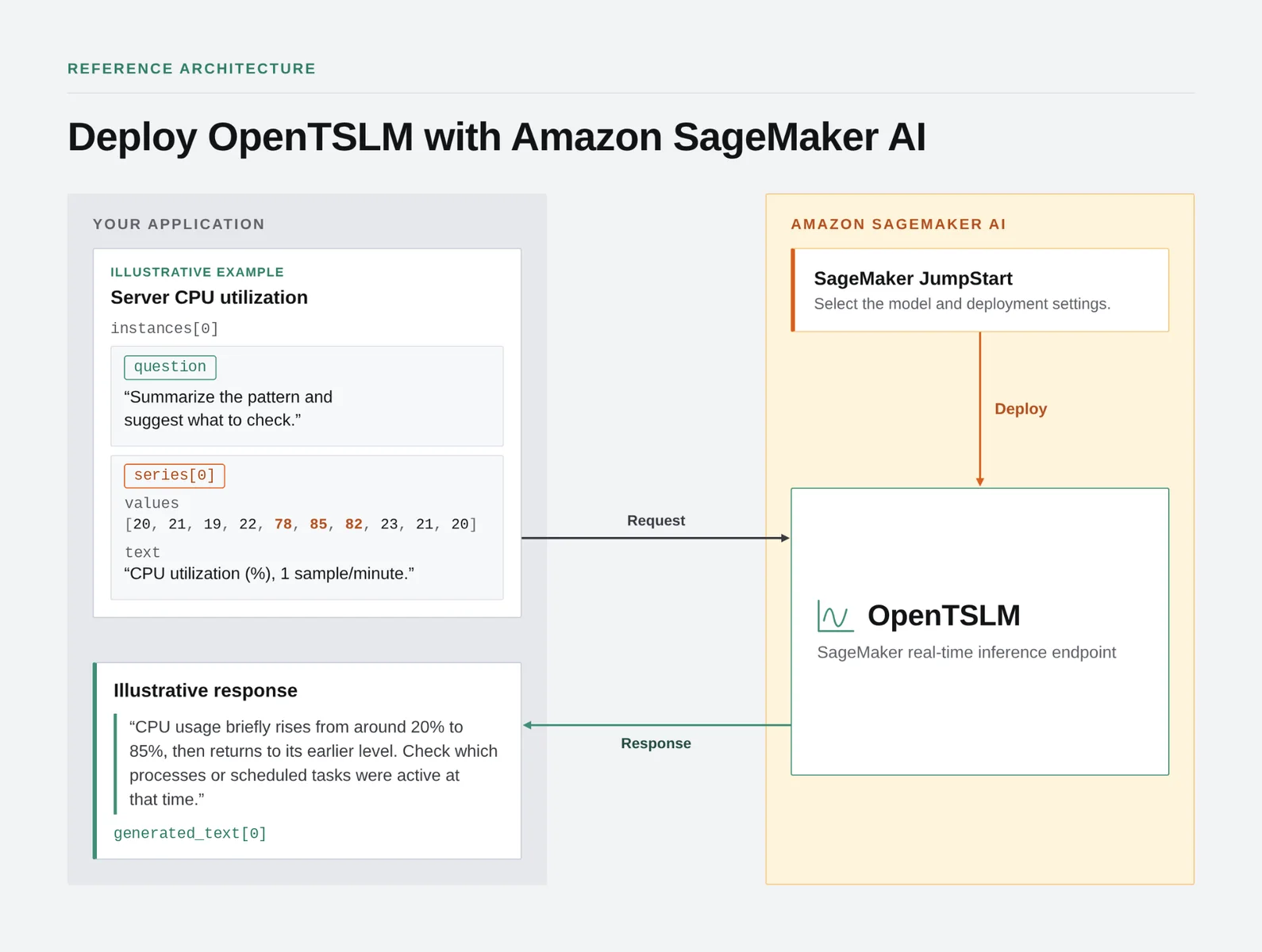
Running OpenTSLM requires a single graphics processing unit with at least 24 gigabytes of memory and bfloat16 support, alongside 32 gigabytes of host memory. The default recommended instance type is ml.g6.2xlarge, which features one NVIDIA L4 graphics processing unit with 24 gigabytes of memory. Additional supported instances include various configurations within the ml.g6 and ml.g5 families.
Source: Original announcement
Worth a read?



Comments