Microsoft unveils new models to cut agent operating costs
Microsoft has introduced seven specialized models for code, security, images, speech, and workflow routing designed to lower operating expenses for always-on AI agents.
2 min read, Thursday, 19 November
Microsoft's AI division has unveiled seven specialized models aimed at reducing the operating costs of always-on AI agents. The release includes models tailored for software development, IT security, image editing, speech recognition, and workflow decisions, positioning them as lower-cost alternatives to systems from OpenAI and Anthropic.
Key facts
- Context window
- 1,000,000 tokens
- MAI Code 2 input price
- $0.50 per million input tokens
- MAI Code 2 output price
- $2.50 per million output tokens
- MAI Cyber 2 Flash input price
- $0.10 per million input tokens
- MAI Cyber 2 Flash output price
- $0.50 per million output tokens
- Promotional input price
- MAI Code 2: $0.50 per million tokens
- MAI Code 2 Flash: $0.05 per million tokens
- Promotional output price
- MAI Code 2: $2.50 per million tokens
- MAI Code 2 Flash: $0.25 per million tokens
- Standard input price
- MAI Code 2: $1 per million tokens
- MAI Code 2 Flash: $0.10 per million tokens
- Standard output price
- MAI Code 2: $5 per million tokens
- MAI Code 2 Flash: $0.50 per million tokens
| Metric | MAI Code 2 | MAI Code 2 Flash |
|---|---|---|
| Promotional input price | $0.50 per million tokens | $0.05 per million tokens |
| Promotional output price | $2.50 per million tokens | $0.25 per million tokens |
| Standard input price | $1 per million tokens | $0.10 per million tokens |
| Standard output price | $5 per million tokens | $0.50 per million tokens |
New Coding and Work Models
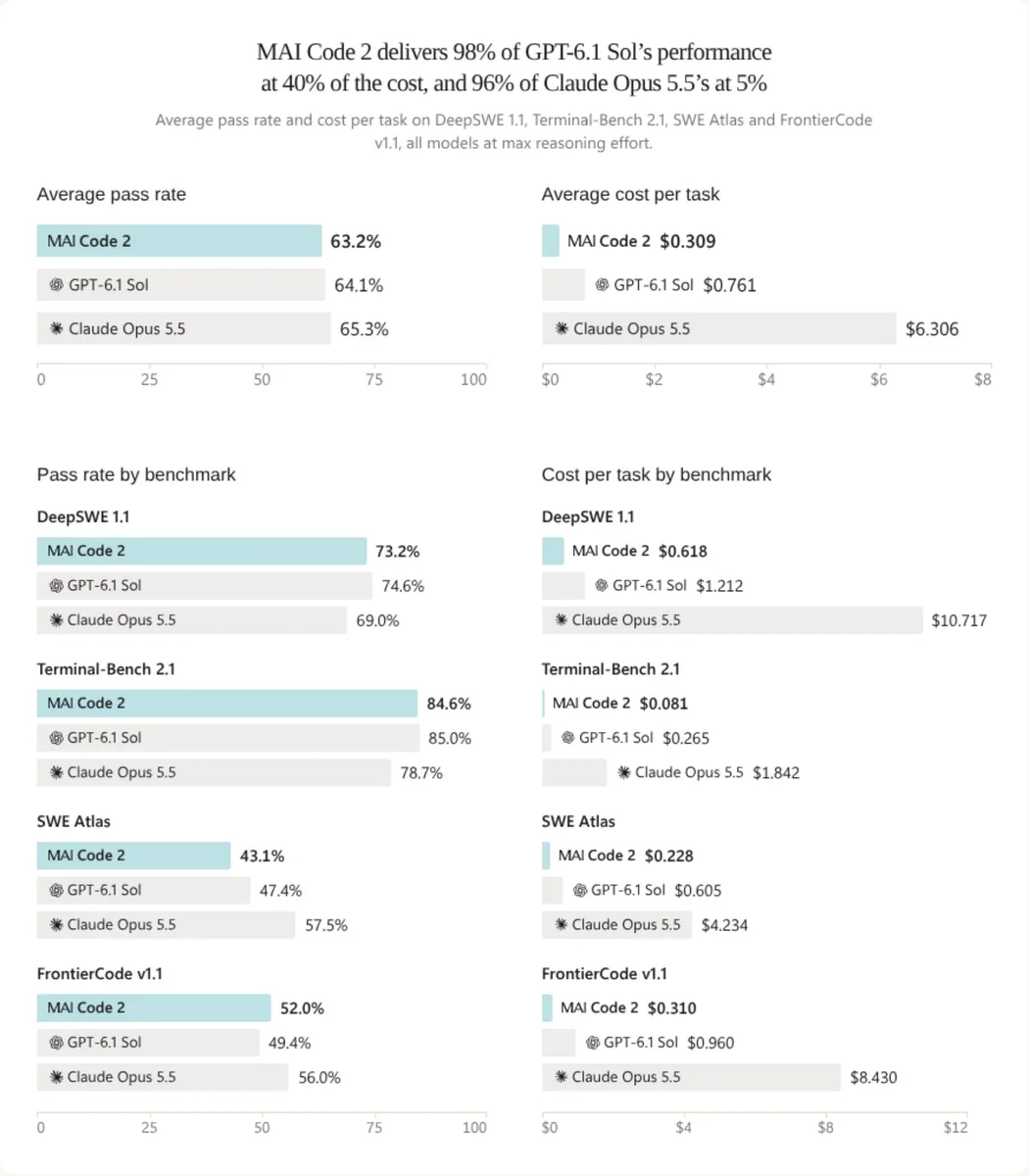
The coding lineup is led by MAI Code 2, which Microsoft reports reaches 98 percent of the performance of GPT-6.1 Sol across four benchmarks at 40 percent of the cost. A smaller variant, MAI Code 2 Flash, is designed for routine fixes and explanations. Additionally, MAI Work Flash integrates into Microsoft 365 and Fabric IQ, handling tasks across Excel, PowerPoint, and Word while consuming fewer input tokens.
Security and Routing Updates
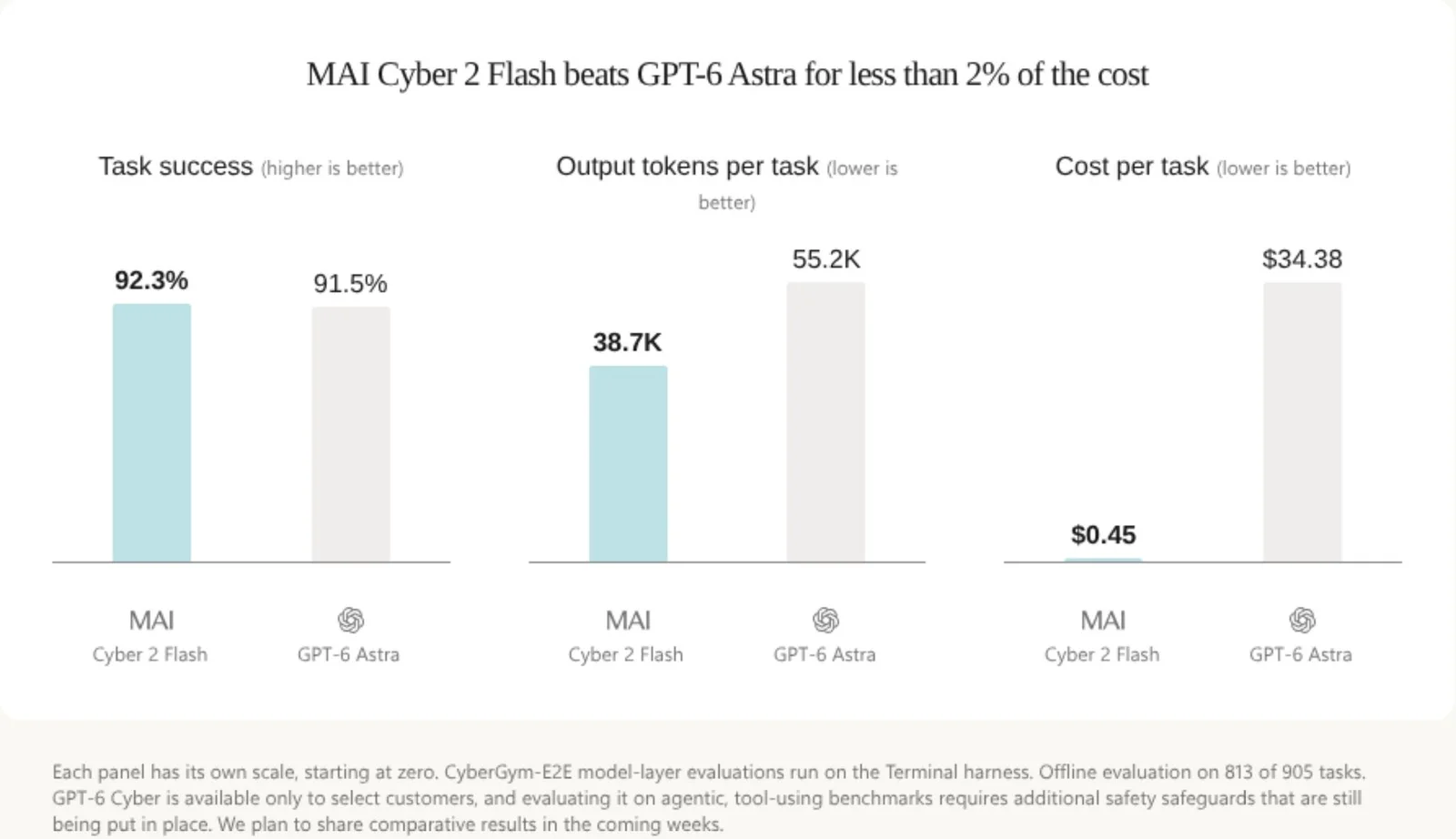
For IT security, MAI Cyber 2 Flash resolves tasks in the CyberGym-E2E vulnerability benchmark while operating at a fraction of the per-task cost of comparable models. Its context window spans one million tokens, marking a fourfold increase over its predecessor.
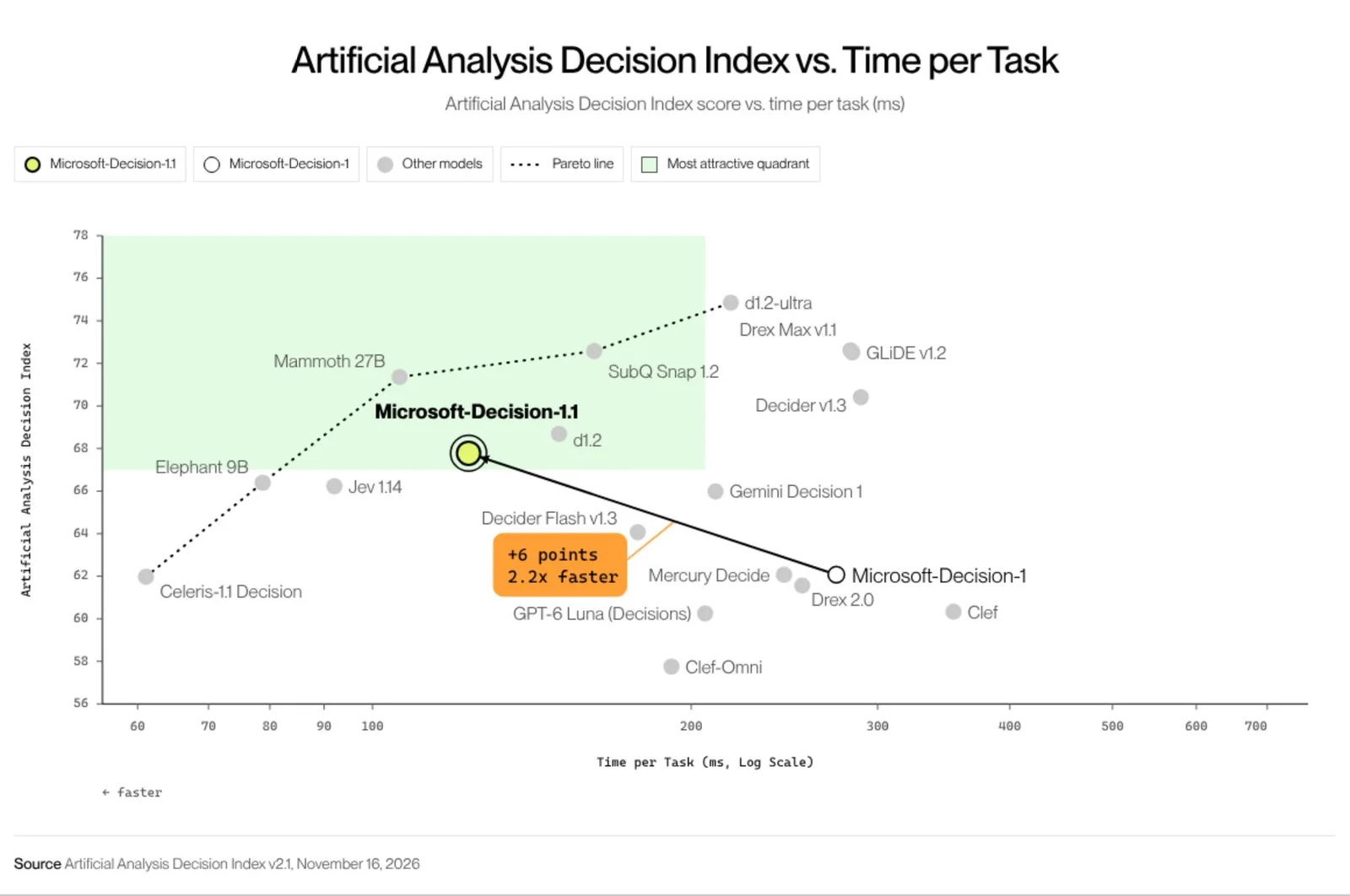
For workflow routing and classification, the Decision 1.1 model is built on Google's mixture-of-experts model Gemma 4 26B A4B — a machine learning architecture that routes inputs to specialized sub-networks rather than activating the entire network at once. It achieves faster execution and lower costs compared to prior versions.
Media and Speech Capabilities
In image editing, MAI Image 2.7 features object manipulation capabilities and transparent background generation while leading specific evaluation leaderboards. Meanwhile, MAI Realtime 1 serves as Microsoft's first speech-to-speech model, featuring compatibility with the OpenAI Realtime API to support voice applications and customer service workflows.
Enterprise customers will also be able to fine-tune selected model weights using their own data within the Azure cloud environment, keeping customizations secure.
Source: Original announcement
Worth a read?
Comments