Microsoft announces third-generation Maia 300 chip for 2027 production workloads
Microsoft has announced the Maia 300, a custom in-house AI chip designed to serve as the primary inference system for its cloud products and services starting in 2027.
2 min read·Tuesday, 13 October
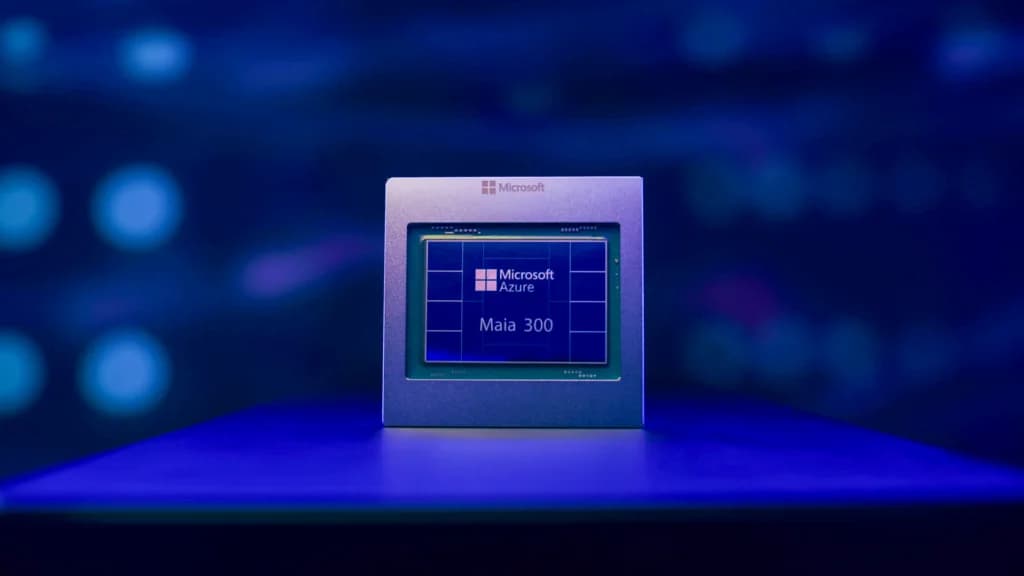
The Microsoft Azure Maia 300 custom AI processor.
Microsoft is introducing its third-generation custom processor, the Maia 300 chip, designed to serve as the primary infrastructure for its cloud services and reasoning systems.
The processor will begin rolling out to production artificial intelligence workloads in 2027. Scott Guthrie, executive vice president of Microsoft's cloud group, stated that the chip is expected to deliver 40 percent more tokens per megawatt compared to leading graphics processing unit systems. In a full 96-accelerator configuration, the hardware reportedly delivers up to seven times the rack-scale token throughput of its predecessor, the Maia 200.
These efficiency gains are intended to help Microsoft rely primarily on its own silicon rather than external suppliers like Nvidia and AMD. The company plans to scale the Azure Maia family to multi-gigawatt deployments starting in 2027.
Architecture and Design
The Maia 300 utilizes a new chiplet architecture built on Taiwan Semiconductor Manufacturing Company's N2P process node. This design separates compute, memory controller, and input-output functions. According to the Azure hardware team, this layout increases the silicon area dedicated to computing performance while allowing each function to use tailored technology.
The hardware is built to support emerging workloads such as long-context reasoning, latency-sensitive conversational experiences, and sustained agentic tasks that require multiple steps to complete. The processor will also support Microsoft's internal model development, working alongside leadership efforts led by Microsoft AI CEO Mustafa Suleyman to co-design software and hardware stacks.
The new hardware follows the Maia 200, which was announced in January and currently powers production workloads across services such as Microsoft Copilot, GitHub Copilot, Microsoft Foundry, and internal AI models.
The Ultimate 2026 Free AI API Engine: Top 10 Provider Blueprints & Setup GuideFree guide


Comments