Jeveration brings single-pass image generation to vision-language models
A new framework called Jeveration adapts fast, parallel prediction models to generate high-quality images in a single forward pass.
2 min read, Friday, 20 November
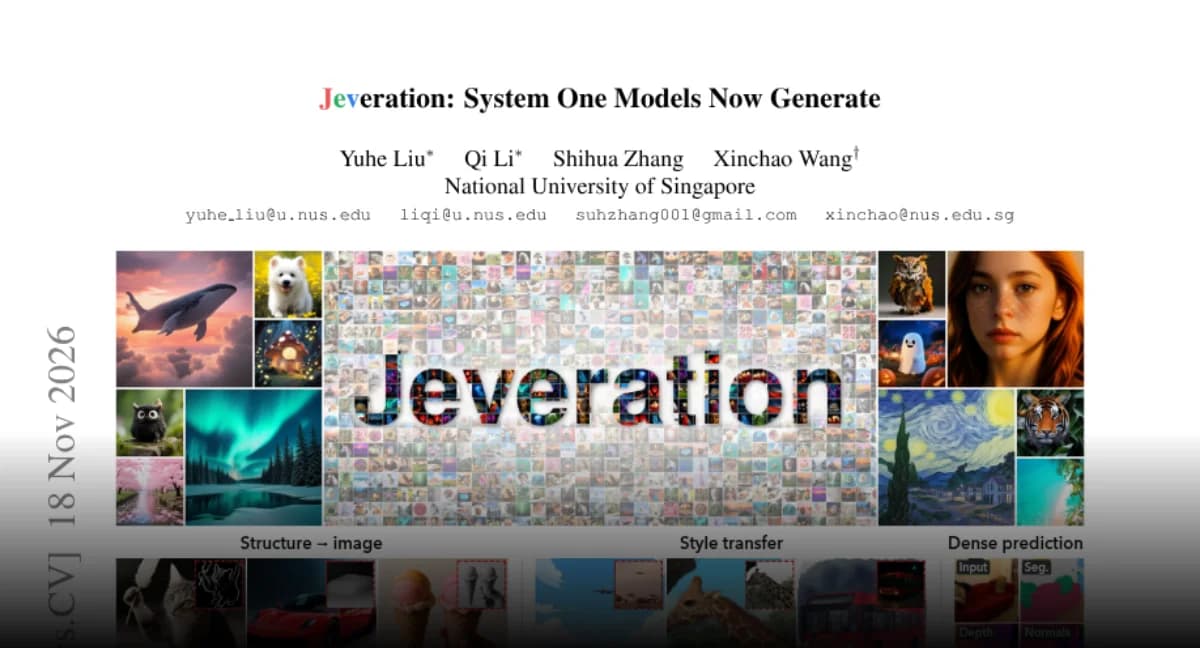
Fast decision-making paradigms typically used for parallel prediction are now expanding into visual creation. A new approach called Jeveration demonstrates that these methods can produce high-quality images in a single forward pass. Rather than training an entirely new architecture from scratch, the system builds directly upon a frozen vision-language model — an artificial intelligence system trained to understand both images and text. By repurposing this existing visual and semantic knowledge, the framework adapts the model for holistic image generation.
Key facts
- Image generation speed
- 78 ms
- Image resolution
- 512x512
- Speed improvement
- up to 122x faster
Solving the Consistency Challenge
A primary difficulty in single-pass generation is maintaining global consistency across the entire output. A text prompt often allows for many valid visual interpretations, but parallel prediction streams must converge on a single, coherent picture rather than disjointed patches. To solve this, Jeveration conditions all output positions on a shared random state to coordinate the parallel predictions. This mechanism ensures that each individual draw yields a distinct yet internally consistent image.
Direct image supervision often causes models to ignore this shared random state. To prevent this, the researchers first learn a distribution over discrete image codes — compact numerical representations of visual features — to properly guide single-pass generation. Beyond standard text-to-image tasks, this architecture unifies multiple capabilities into one checkpoint.
Unifying Visual Tasks
A single model checkpoint now supports text-to-image generation, image-to-image generation, and dense prediction simultaneously. Each task is executed entirely within one forward pass. Experimental results show that Jeveration can render a 512x512 pixel image in just 78 milliseconds. This performance is up to 122 times faster than existing unified models, while still maintaining competitive image quality and dense prediction accuracy.
Source: Original announcement
Worth a read?
Comments