Grounding artificial intelligence agents in biological reality
Google researchers have introduced new frameworks that connect artificial intelligence agents directly to physical laboratory robotics.
3 min read·Saturday, 17 October
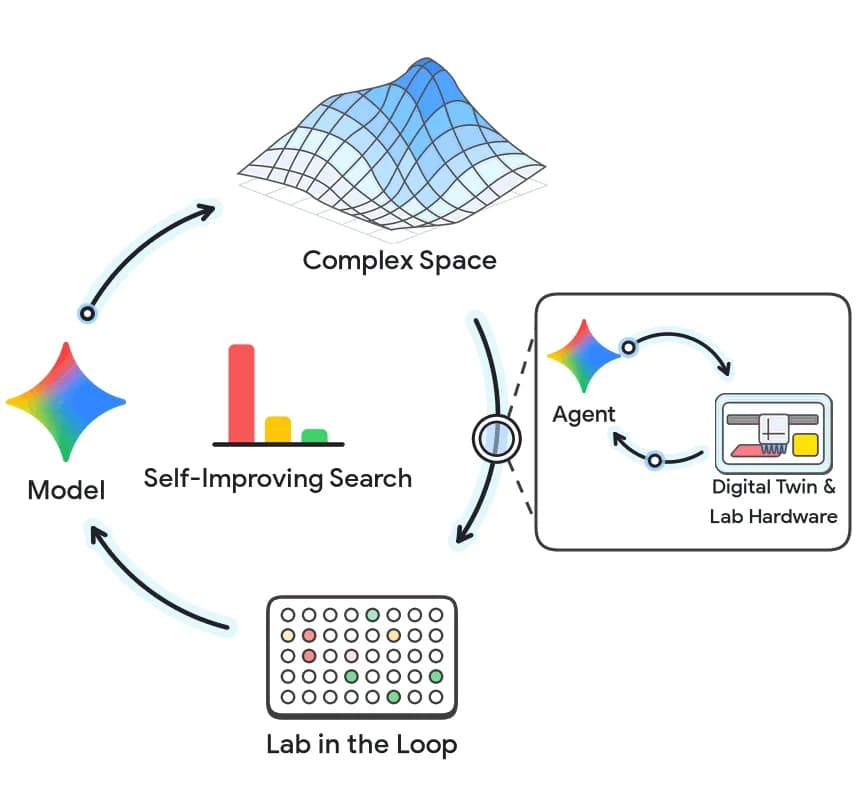
A diagram of the self-improving search cycle connecting digital lab hardware and AI agents.
Frontier artificial intelligence systems have the potential to transform biology research and drug discovery by navigating vast search spaces. A single one-hundred-amino-acid protein spans an immense number of possible sequences, requiring dynamic exploration. However, realizing the vision of autonomous wet labs requires solving two intertwined challenges.
First, frontier models still struggle to reason reliably about three-dimensional geometry and physical state, which creates automation hurdles for specialized liquid-handling robots. Second, while computational hypothesis generation is advancing rapidly, real-world wet-lab experiments have not kept pace, making experimental readouts a major bottleneck. Google researchers have shared three projects highlighting progress on bridging this gap.
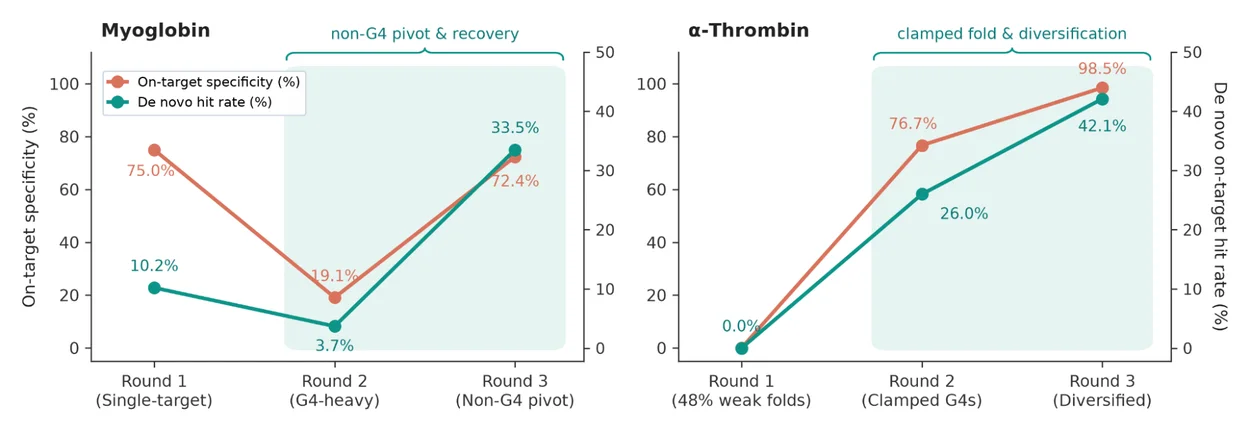
Line charts showing specificity and hit rate improvements across multi-round aptamer optimization. · Source ↗
Grounding agents in physical reality
The VERified Infrastructure for Discovery Laboratories, or VERID framework, bridges the gap between high-level reasoning and physical lab reality. It acts as a semantic digital twin — a live, stateful three-dimensional entity tree tracking everything from robotic arm geometry to individual well volumes and reagent identities. Built on top of the open-source PyLabRobot framework, VERID allows artificial intelligence agents to check deck layouts, run fast virtual dry runs to catch collisions, block invalid hardware commands, and capture synchronized video logs for debugging.
Learning with aptamers
Because computational models cannot fully predict wet-lab reactions, agents need empirical readouts to refine their hypotheses. In a project focusing on DNA aptamers — short strands of DNA used to bind target proteins — researchers used a closed-loop system over three design-test-iteration cycles. A complete aptamer cycle takes just seven to ten days because DNA can be synthesized in pooled libraries and read out directly by sequencing.
Across three rounds on two protein targets, myoglobin and alpha-thrombin, the system raised confirmed on-target hit rates significantly. When agents initially prioritized raw binding affinity for myoglobin, they enriched sticky, non-specific motifs that adhered to bare magnetic beads. Recognizing this artifact from the wet-lab data, the agents autonomously revised their design rules for the next round to recover specificity and improve hit rates.
Accelerating protein binder design
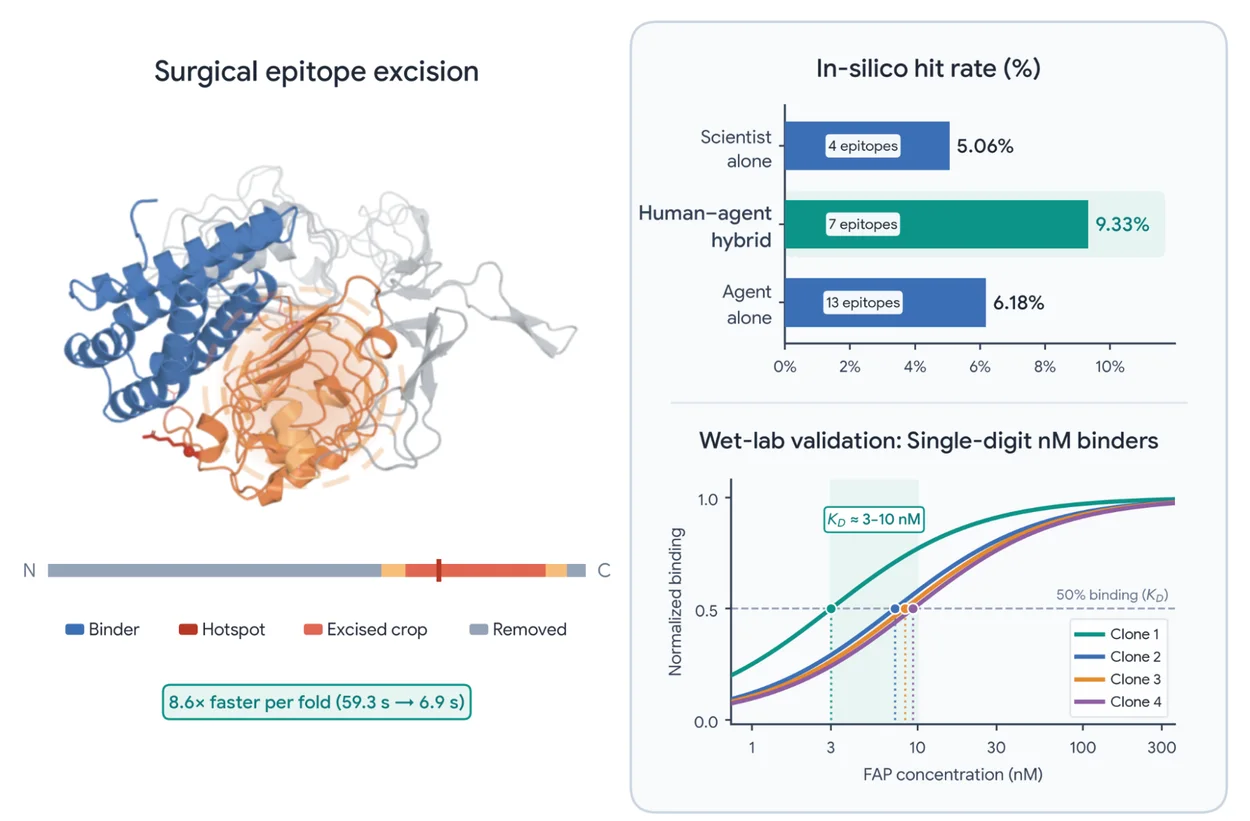
Closing the loop for proteins is more complex because they must be expressed biologically rather than synthesized chemically. Applying the workflow to fibroblast activation protein alpha, a large receptor overexpressed in solid tumors, top designs yielded binders with single-digit nanomolar affinity — a level of tight binding typically achieved only after extensive laboratory optimization.
To manage the high computational cost of re-folding complexes, the pipeline surgically excised just the local binding pocket during folding. This accelerated each cycle more than eightfold without losing structural accuracy, turning tactical design choices into levers that large language model agents can optimize.
Surgical epitope excision results and wet-lab binding validation curves for protein binders. · Source ↗
The Ultimate 2026 Free AI API Engine: Top 10 Provider Blueprints & Setup GuideFree guide


Comments