Google introduces agentic video understanding for Gemini models
Google has launched an agentic video processing feature for selected Gemini models. The update dynamically scans visual frames, audio, and transcripts to reduce analysis costs while improving overall accuracy.
Published by Jin · 2 min read · 2 SEPT 2026
- 56.8%
- one million token
- 15 seconds at 1080p
- 3B
- $500M
- 750 million
| Metric | GPT-5.3-Codex | Claude Opus 4.6 |
|---|---|---|
| SWE-Bench Pro | 56.8% | — |
| OSWorld score | 64.7% | — |
| Context Window | — | one million token |
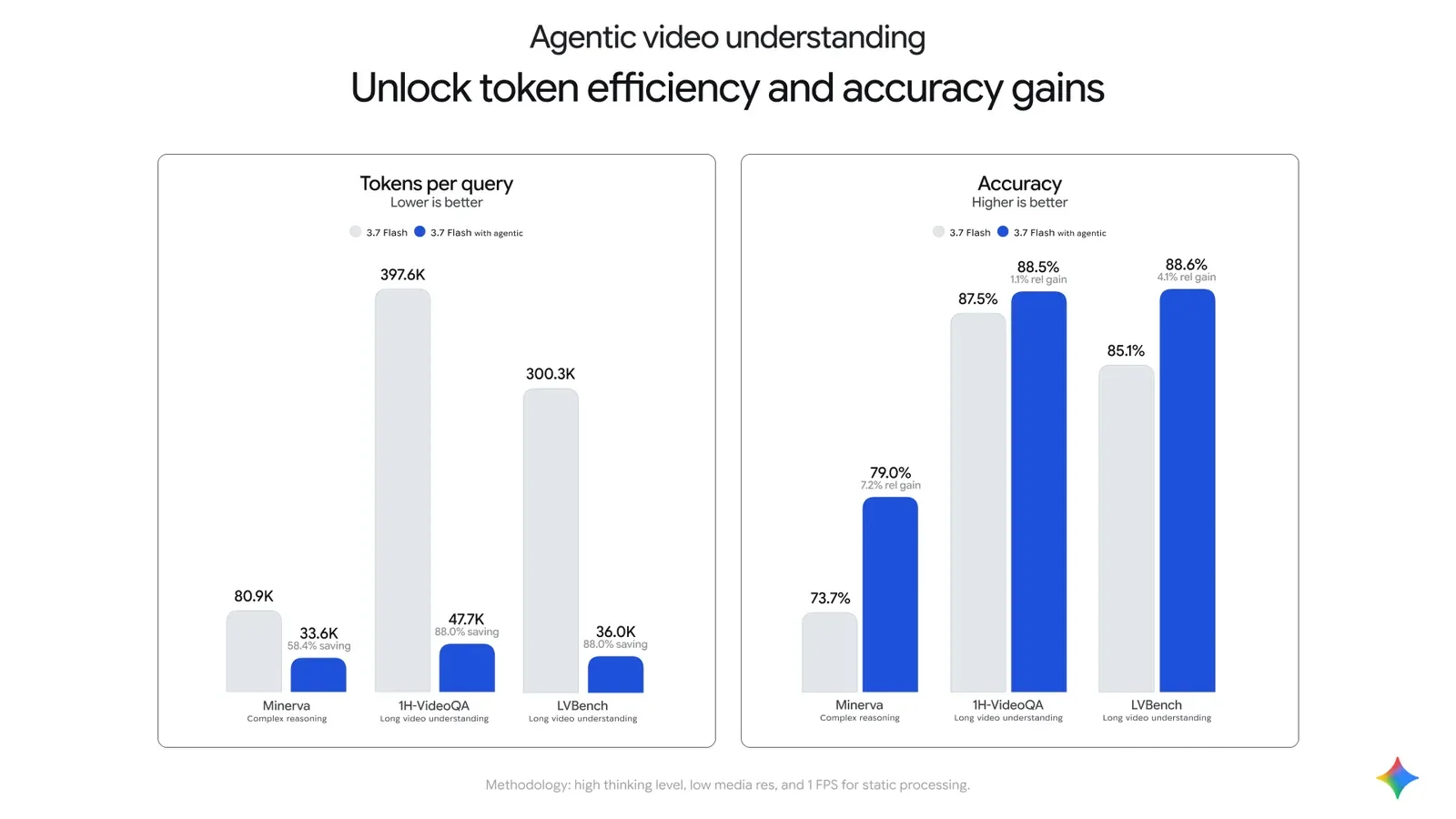
Google has introduced an agentic video understanding feature designed to improve how models process visual media. Available across Gemini 3.7 Flash, 3.6 Flash, and 3.5 Flash-Lite, the new capability shifts away from traditional static frame ingestion toward a dynamic, goal-directed inspection method.
How agentic processing works
Traditional video analysis typically relies on ingesting media at a fixed frame rate, such as one frame per second. This static approach forces developers to choose between high token consumption or missing important visual details.
By contrast, agentic video understanding pairs the model's core reasoning with native video tools. The model actively determines what to watch, adjusts its speed, and selectively queries visual frames, audio tracks, or transcripts. This allows the system to fetch only the specific moments and signals required for a given query.
Performance and benchmarks
According to internal benchmarks, the new feature yields notable efficiency gains, particularly for long-form content ranging from ten-minute guides to multi-hour recordings.
- Token consumption is reduced by up to 88 percent.
- Analysis costs decrease by up to 66 percent.
- Overall accuracy improves by up to 7 percent.
Among the supported models, Gemini 3.7 Flash delivers the optimal combination of quality and cost efficiency, positioning it at the accuracy-to-cost pareto frontier for video tasks.
Source — Original announcement ↗
Worth a read?
Comments · 0