Accelerating drug discovery workflows with Google Antigravity and cheminformatics skills
Google Antigravity with new Cheminformatics Skills automates complex molecule discovery workflows. The system reduces a multi-day drug design cycle down to just one hour.
2 min read·Wednesday, 4 November
Designing new medicines requires curating complex data from charts, figures, and literature, training predictive models, and proposing candidate molecules to synthesize. This workflow typically takes multiple days for a single iteration. Google Antigravity, equipped with new Cheminformatics Skills, accelerates these drug discovery workflows significantly.
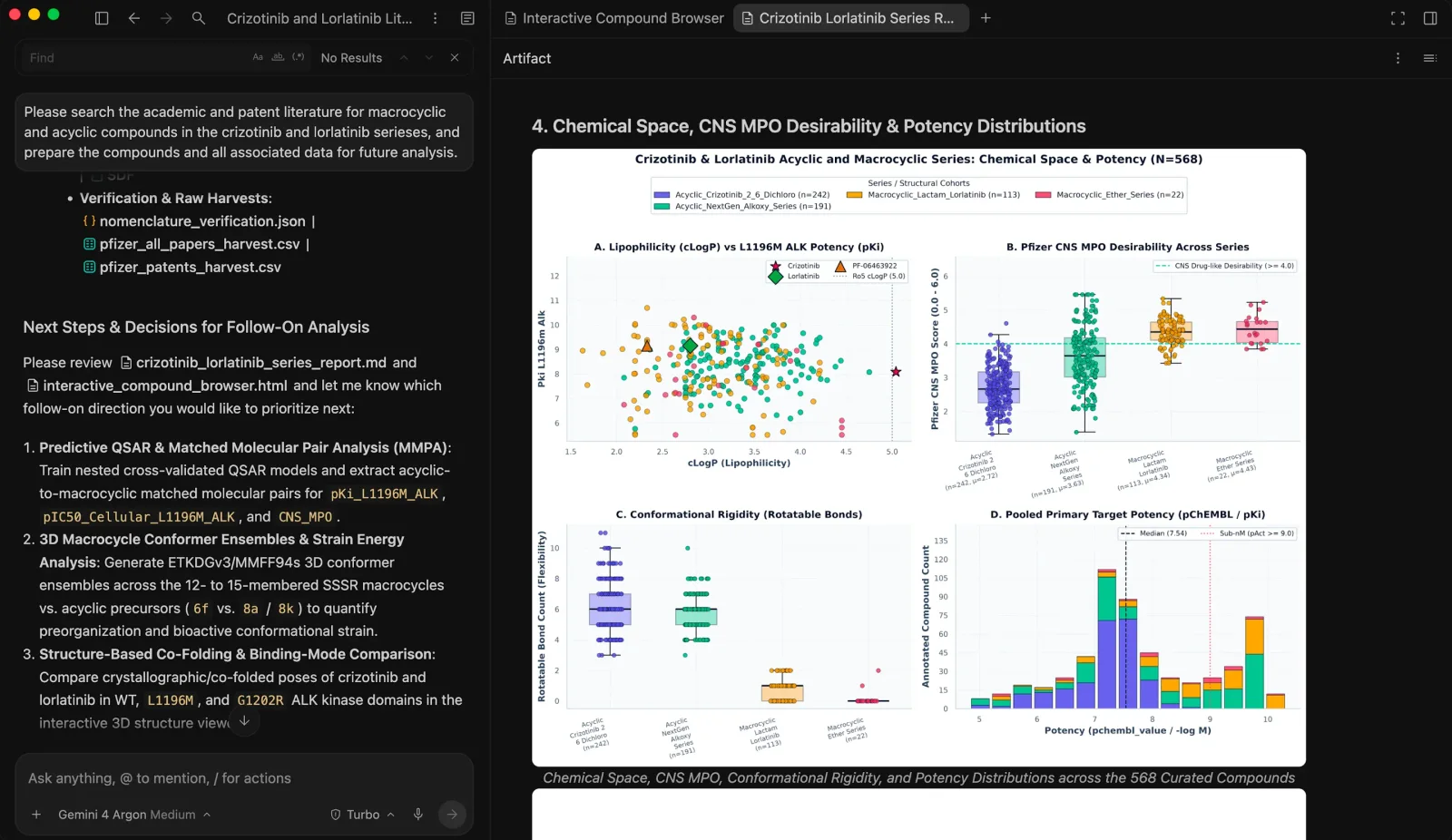
Chemical space, CNS MPO desirability, and potency distributions across curated compound series. · Source ↗
Automating chemistry workflows
Chemistry spans millions of structures across journal articles and vendor catalogs. Despite decades of progress in cheminformatics, scientists still spend considerable time wrangling data. Molecules can be represented in many ways, from text descriptions and images to structure-data files. Advanced cheminformatics systems must unify these sources without error, since altering a single atom or bond describes a completely different compound.
The new Cheminformatics Skills turn the system into a collaborative science workbench with full access to local tooling. The underlying language model handles workflow orchestration, database navigation, and scientific reasoning, while deterministic chemistry tools execute molecular calculations. Grounded in RDKit, an open source cheminformatics toolkit, the skills also connect to curated resources from ChEMBL and PubChem to encode domain best practices directly into the agent workflow.
Rigidifying floppy molecules
In a technical walkthrough demonstrating the system, researchers examined a classic medicinal chemistry technique to improve drug potency: rigidification. Drug molecules often link multiple substructures through rotatable bonds that let the molecule twist into many shapes, making it floppy in solution. To bind its target, a floppy molecule must lock into a single active shape, which weakens binding affinity.
To solve this, chemists rigidify molecules by adding new bonds to limit movement in three-dimensional space. For example, the drug crizotinib is a first-generation small-molecule tyrosine kinase inhibitor used to treat non-small cell lung carcinoma with five major rotatable bonds. In comparison, lorlatinib is a third-generation small-molecule tyrosine kinase inhibitor that resembles crizotinib but has been cyclized at its end to reduce rotatable bonds to zero, leading to higher potency.
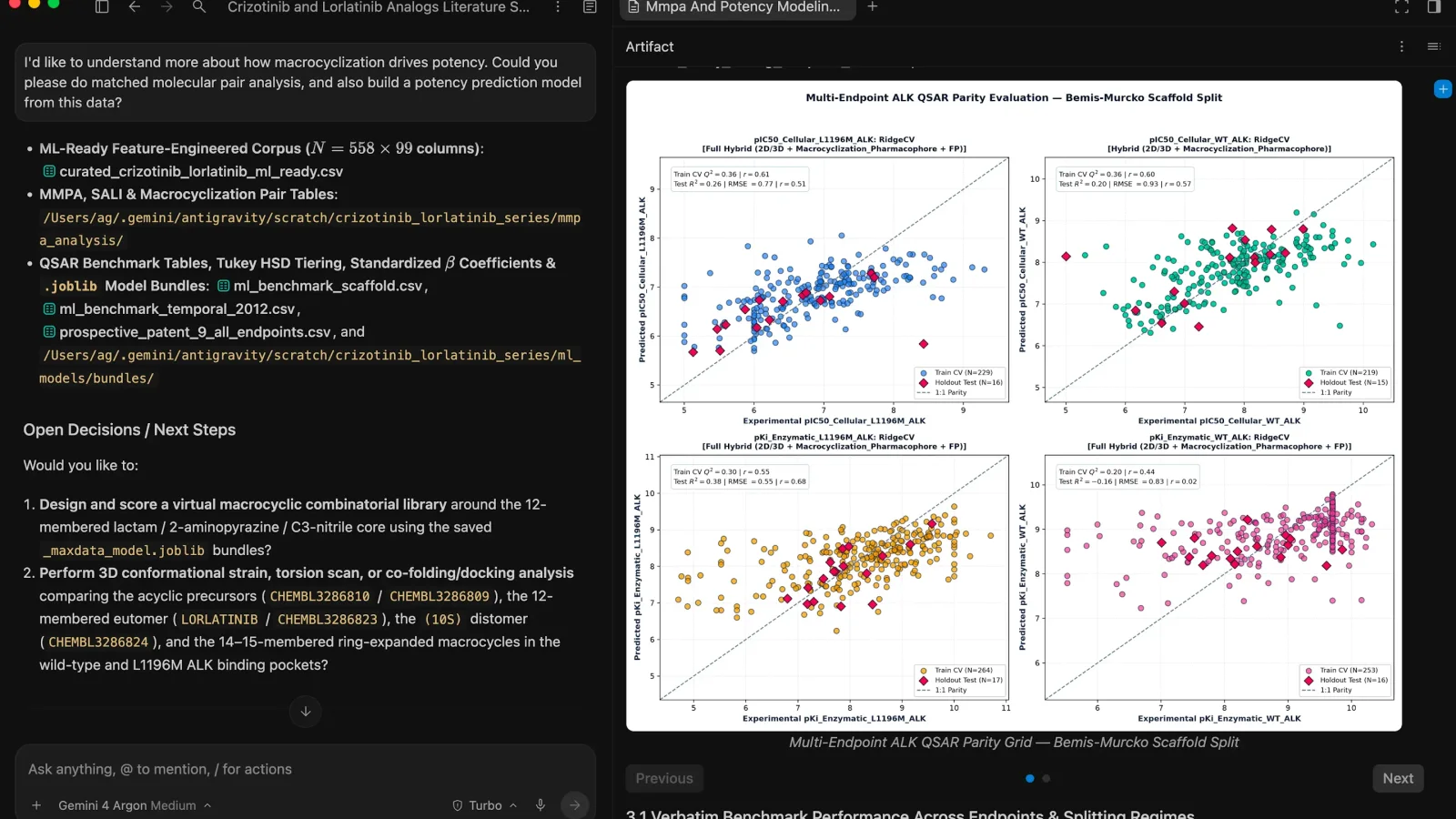
Using real-world lung cancer treatments, an autonomous agent searches through thousands of compounds, performs matched molecular pair analysis, and proposes novel rigidified macrocycles with synthetic routes in just an hour.




Comments