Google DeepMind uses AI agents to formally verify the Signal protocol
Researchers at Google DeepMind have used a new multi-model framework called AlphaProof Code to mathematically prove the security of the actual code running the Signal messaging protocol.
2 min read, Wednesday, 11 November
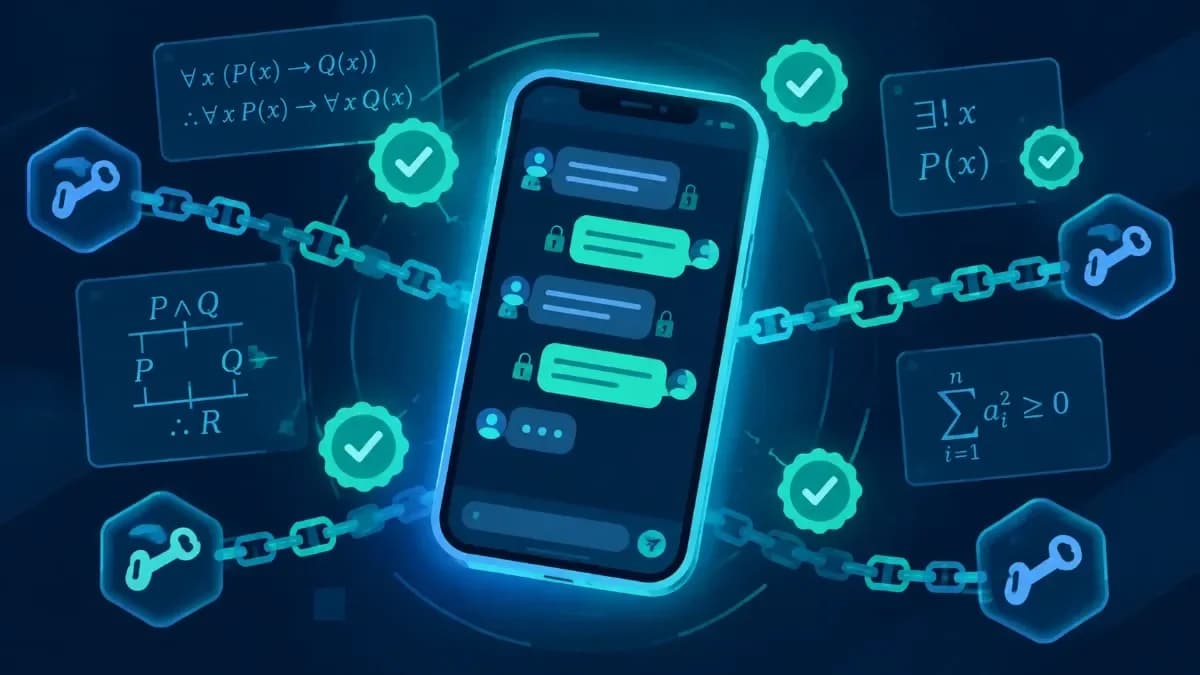
Google DeepMind researchers have used a new agentic framework—a system of autonomous AI models working together toward a goal—to mathematically prove key security properties of the code underlying the Signal protocol. Signal is the underlying technology that protects billions of private messages in apps like Signal and Google Messages.
This marks the first time artificial intelligence has been used to formally verify a widely deployed cryptographic protocol at this level of depth. Formal verification is the process of using mathematics to prove that code runs correctly without flaws, representing the highest standard of security assurance.
Key facts
- Model Name
- Gemini 4 Carbon
- Input Token Price
- $2 per million input tokens
- Output Token Price
- $10 per million output tokens
- SEC-bench Pro Score
- 88.2%
- ExploitGym Score
- 54.8%
- CWE-bench Score
- 71.0%
- Input Token Price
- Gemini 4 Argon: $2 per million input tokens
- Gemini 4 Carbon: $2 per million input tokens
- Output Token Price
- Gemini 4 Argon: $10 per million output tokens
- Gemini 4 Carbon: $10 per million output tokens
- Indirect Prompt Injection Attack Success Rate
- Gemini 4 Argon: 0.7%
- Gemini 4 Carbon: 0.0%
| Metric | Gemini 4 Argon | Gemini 4 Carbon |
|---|---|---|
| Input Token Price | $2 per million input tokens | $2 per million input tokens |
| Output Token Price | $10 per million output tokens | $10 per million output tokens |
| Indirect Prompt Injection Attack Success Rate | 0.7% | 0.0% |
How AlphaProof Code works
AlphaProof Code is a multi-LLM framework that divides the labor of formal verification similarly to a human research team. Human experts collaborate with AI models to translate security goals into formal mathematical specifications, with humans reviewing every translation.
From there, agents powered by Gemini Carbon execute the proofs. The system generated over six million lines of Lean, a computer language used to mathematically prove code accuracy. Next, the agents audited their own proofs, highlighting just one percent of the codebase for human review. Because the Lean language automatically checks the remainder of the code, experts were able to focus their time where human judgment is most critical.
Bridging design and implementation
Most protocol verification stops at the design level. However, the Google DeepMind agents went further by proving that the compiled code fulfills key security properties down to the exact code running on user devices. This includes ensuring that messages remain protected before and after a device is temporarily compromised.
Bridging the gap between design and implementation makes proofs significantly more complex. Despite this complexity, the verification process took just four weeks—a task that historically requires expert teams years to complete. To test the system, researchers reintroduced two real, previously fixed bugs into an isolated version of the Signal code. In both cases, the framework successfully produced a machine-checked proof showing the buggy version was insecure.
The research team is open-sourcing their formal verification artifacts for community use, laying the groundwork to help secure other vital systems ranging from medical device firmware to power grid software.
Source: Original announcement
Worth a read?


Comments