Fixing recurrent state instability in Gated DeltaNet-2 models
Linear attention models struggle with training instability during long-context processing due to an asymmetry in how they erase and update internal states.
2 min read, Friday, 27 November
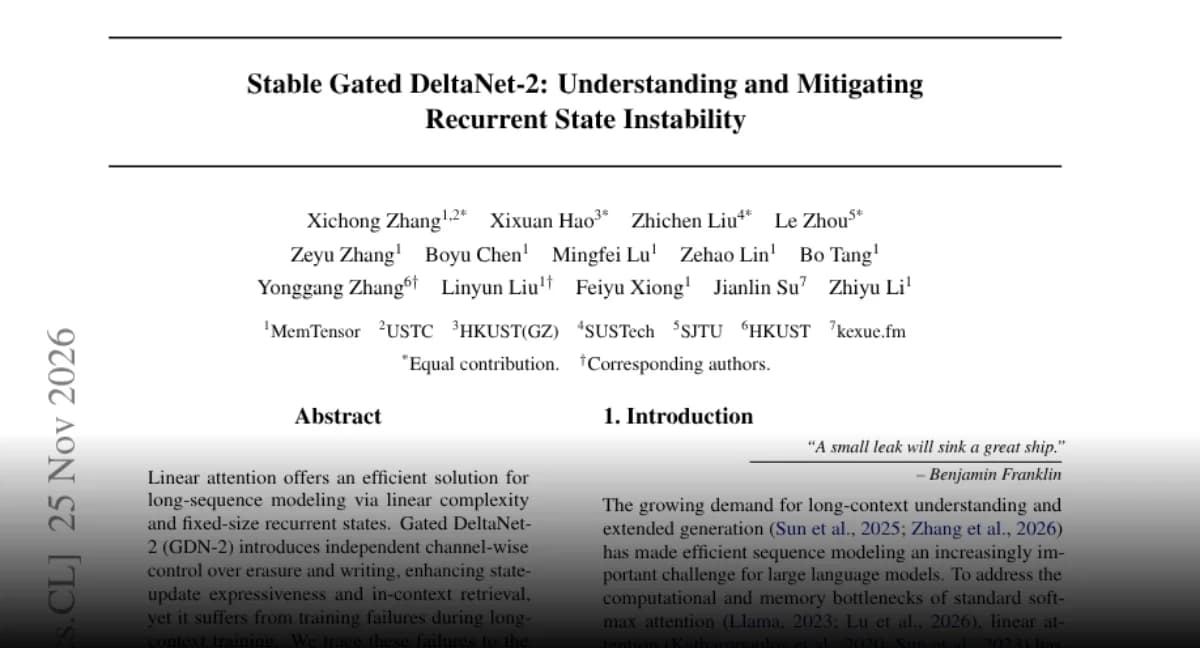
Linear attention offers an efficient solution for long-sequence modeling via linear complexity — meaning computation scales in a straight line relative to sequence length — and fixed-size recurrent states. Gated DeltaNet-2, known as GDN-2, introduces independent channel-wise control over erasure and writing. While this enhances state-update expressiveness and in-context retrieval, it suffers from severe training failures during long-context training runs.
Key facts
- Model scale
- ~1.6B parameters
- Recurrent setting RULER boost
- 6.80 points
- Hybrid setting downstream task boost
- 0.62 points
- 128K RULER score boost
- Gated DeltaNet-2: —
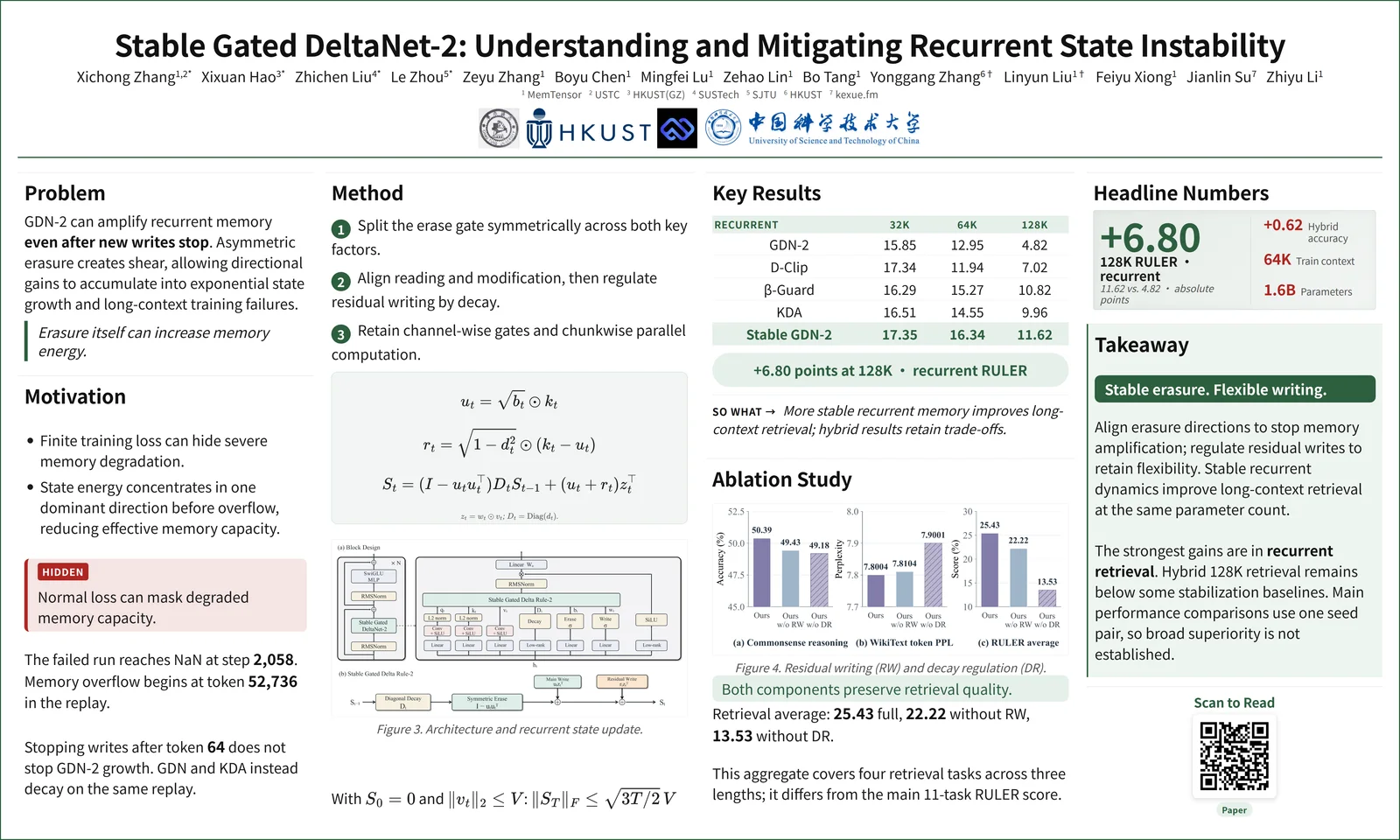
- Stable Gated DeltaNet-2: +6.80 points (recurrent setting)
- Downstream accuracy across 9 tasks
- Gated DeltaNet-2: —
- Stable Gated DeltaNet-2: +0.62 points (hybrid setting)
| Metric | Gated DeltaNet-2 | Stable Gated DeltaNet-2 |
|---|---|---|
| 128K RULER score boost | — | +6.80 points (recurrent setting) |
| Downstream accuracy across 9 tasks | — | +0.62 points (hybrid setting) |
The root cause of instability
Researchers traced these failures to the asymmetry between reading and modification directions during erasure. This creates non-normal erase operators whose directional gains accumulate across tokens. As a result, the system triggers exponential state growth even when no new writes occur.
The Stable GDN-2 solution
To resolve this issue, the team proposed Stable GDN-2. This approach relies on two core mechanisms:
- Symmetric erasure to ensure non-expansive state propagation.
- Decay-regulated residual writing to preserve writing flexibility.
Theoretically, the developers established an O(square root of T) upper bound on recurrent state growth while still retaining chunkwise parallel computation for faster processing.
Experimental results
Experiments on models with approximately 1.6 billion parameters show that Stable GDN-2 achieves stable training alongside noticeably improved long-context retrieval.
Compared to the original GDN-2 architecture, the new method boosts the 128K average RULER score — a benchmark measuring long-context retrieval capabilities — by 6.80 points in the recurrent setting. Furthermore, it raises average accuracy across nine downstream tasks by 0.62 points in the hybrid setting, proving that stability enhancements do not come at the cost of overall capability.
Source: Original announcement
Worth a read?



Comments