Coding agents outperform video models in visual reasoning tasks
Recent tests show that coding agents writing rendering programs are significantly better at visual reasoning tasks than traditional video generation models.
2 min read, Friday, 27 November
Key facts
- Benchmark
- VBVR-Pro-Bench
- Benchmark instances
- 500-instance suite
- arXiv ID
- arXiv:2611.34813
- Score
- Codex with gpt-6-astra: 0.923
- Claude Code with Fable 5.1: 0.894
- Gemini CLI with Gemini 3.1 Pro: 0.893
- GLM-5: 0.572
| Metric | Codex with gpt-6-astra | Claude Code with Fable 5.1 | Gemini CLI with Gemini 3.1 Pro | GLM-5 |
|---|---|---|---|---|
| Score | 0.923 | 0.894 | 0.893 | 0.572 |
Testing Visual Reasoning
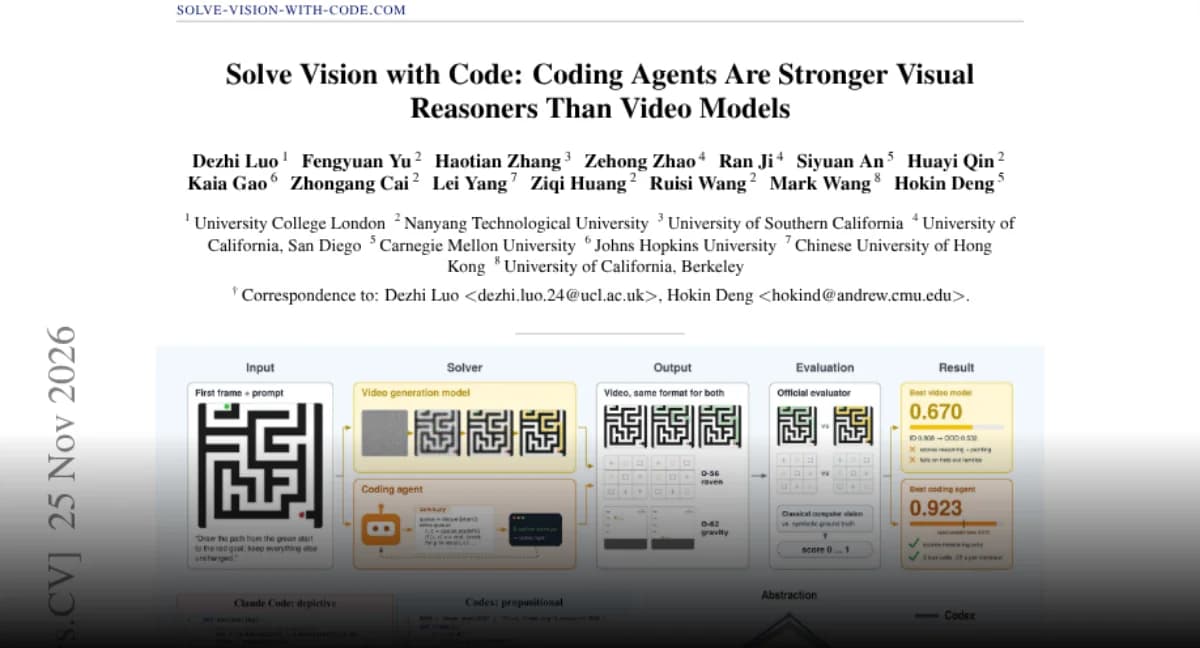
Video generation models are frequently evaluated on their ability to act as visual reasoners. Given a first frame and a natural language prompt, the goal is to produce a video where a specified task is successfully carried out. This approach is often considered advantageous because the reasoning unfolds natively within the visual medium of frames rather than through secondary language or code.
However, researchers recently tested whether this native route is genuinely more reliable than a symbolic alternative under identical conditions. Instead of generating pixels through diffusion or denoising, they instructed coding agents to write a program that renders the answer video. An unmodified rule-based evaluator then scores the output against the same inputs and success criteria.
Benchmark Performance
The evaluation used VBVR-Pro-Bench, a five hundred instance suite spanning five cognitive categories with symbolic ground truth. Each agent received a single attempt per instance with no access to metadata, generation models, or ground truth answers.
Closed-model coding agents demonstrated a clear advantage over video models. Codex paired with gpt-6-astra scored 0.923, Claude Code paired with Fable 5.1 scored 0.894, and Gemini CLI paired with Gemini 3.1 Pro scored 0.893. Each of these scores sat more than 0.22 above the strongest traditional video model.
Among open-weight alternatives, the strongest performer was GLM-5, reaching a score of 0.572. This placed it above all video generation models except for those specifically trained with reinforcement learning techniques.
Program Types and Implications
These findings suggest that for tasks whose solutions can be computed from a first frame and a prompt, program synthesis currently provides a substantially more reliable path to visual reasoning than direct video generation.
Further analysis of the agent-generated code highlights two distinct categories of programs:
- Depictive programs, which navigate the image to recover a transferable scheme.
- Propositional programs, which operate directly on hard coded values.
Understanding how visual reasoning unfolds inside agent-written programs offers new perspective on the fundamental nature of machine reasoning.
Source: Original announcement
Worth a read?


Comments