CounterPoint improves temporal alignment in physical artificial intelligence systems
Recent research shows that standard multimodal aligners fail to distinguish between distinct physical executions recorded under identical conditions due to temporal pooling.
2 min read, Tuesday, 24 November
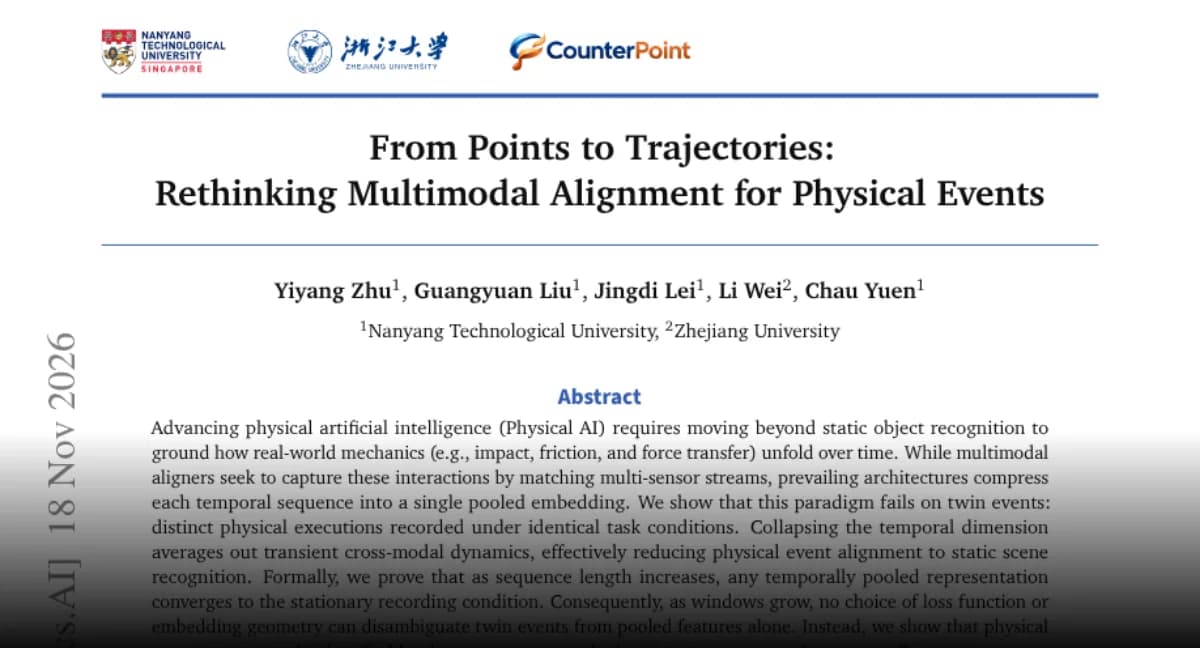
Advancing physical artificial intelligence requires moving beyond static object recognition to understand how real-world mechanics like impact, friction, and force transfer unfold over time. While multimodal aligners — systems that match data streams from multiple sensors — seek to capture these physical interactions, prevailing architectures compress each temporal sequence into a single pooled embedding. This means the model reduces a sequence of data points down into one averaged summary vector.
Key facts
- Paper Title
- From Points to Trajectories: Rethinking Multimodal Alignment for Physical Events
- Authors
- Yiyang Zhu and 4 other authors
- Proposed Module
- CounterPoint
The problem with twin events
This standard approach fails when handling twin events, which are distinct physical executions recorded under identical task conditions. Collapsing the temporal dimension averages out transient cross-modal dynamics, effectively reducing physical event alignment to static scene recognition. As sequence length increases, any temporally pooled representation converges to the stationary recording condition. Consequently, as observation windows grow, no choice of loss function or embedding geometry can disambiguate twin events from pooled features alone.
Recovering the event gap
Instead, physical events are uniquely identified by what researchers call the event gap. This refers to the instantaneous, synchronous co-fluctuations across modalities that are erased by pooling and accumulate only along unpooled trajectories. To recover this missing signal, the team behind the study introduced CounterPoint, a lightweight plug-in module that strips out each modality's temporal mean to score frame-level cross-modal agreement.
When integrated across four state-of-the-art multimodal aligners, CounterPoint shifts representations from coarse condition matching to fine-grained physical event alignment. It consistently outperforms existing temporal alignment methods, demonstrating a reliable way to capture dynamic real-world physics without losing critical temporal details.
Source: Original announcement
Worth a read?
Comments