Coda-DaVinci improves Code2Video generation using task-adaptive agents
A new framework called Coda-DaVinci uses task-adaptive agents and 3D proxies to improve structure and consistency in video generation.
2 min read, Monday, 23 November
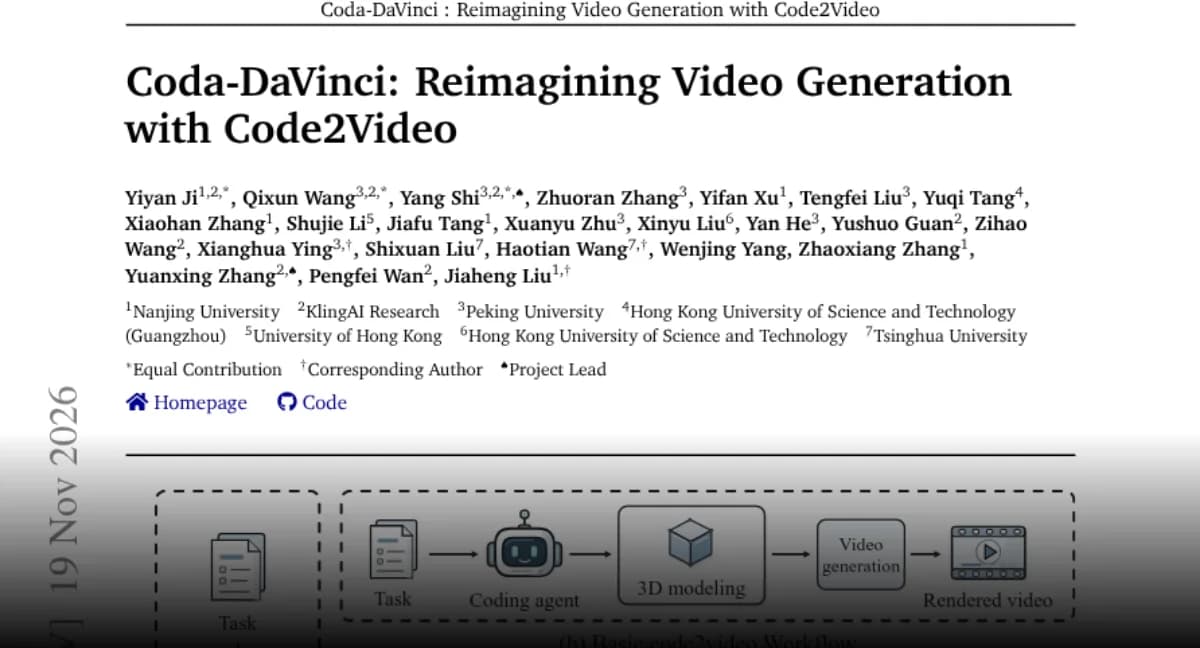
Source page video
Demonstration of Coda-DaVinci generating coherent video sequences from code and prompts using agent-authored 3D proxies.
Generating coherent videos from code and prompts remains a challenge in artificial intelligence. A technique known as Code2Video uses agent-authored 3D proxies — simplified three-dimensional digital models that represent objects and scenes — to guide video generation. These proxies give creators explicit control over structure and dynamics. However, the best ways to construct proxies and prompts for high quality have remained unclear.
Researchers recently studied proxy granularity, physics simulation, and prompting through controlled experiments and blinded human evaluations. The findings reveal distinct trade-offs depending on the task. Coarse proxies work best for natural motion, while medium-grained proxies favor consistency across frames. Additionally, adding physics simulations and aligning prompts with the proxies helps improve average video quality.
Key facts
- Primary Author
- Yiyan Ji
- Total Authors
- 23
- Model Name
- Coda-DaVinci
Introducing Coda-DaVinci
Guided by these insights, the researchers developed Coda-DaVinci, a task-adaptive agentic framework — a system of autonomous software agents that work together to complete complex goals. This framework dynamically selects between proxy-guided generation and direct generation. It also adapts the modeling granularity for each entity in a scene and coordinates physics simulations with proxy-grounded prompting.
A multi-agent harness preserves scene assets and guides repairs through visual inspection and independent review. Experimental results show that this approach achieves leading instruction following on the VTR benchmark and high scene consistency on R2M. It also improves physical plausibility over direct generation methods and delivers higher visual realism than existing Code2Video baselines.
Long-Video Evaluations
When evaluated on longer videos, Coda-DaVinci demonstrates strong gains in event structure and consistency across successive interactions. At the same time, the evaluations reveal some limitations, particularly regarding transition stability and adherence to specific scene settings.
Ultimately, this work highlights how coordinating multiple specialized agents can overcome traditional hurdles in video synthesis, paving the way for more reliable and controllable generative media tools.
Source: Original announcement
Worth a read?

Comments