Bypassing inference bottlenecks with retrieve-for-train
Modern search systems struggle to balance complex queries with fast response times. A new framework uses offline reinforcement learning to train a lightweight diffusion model, bypassing slow autoregressive thinking budgets.
Published by Jin · 3 min read · 16 SEPT 2026
- Efficient, Property-Aligned Fan-Out Retrieval via RL-Compiled Diffusion
- Pengcheng Jiang and 10 other authors
- R4T (Retrieve-for-Train)
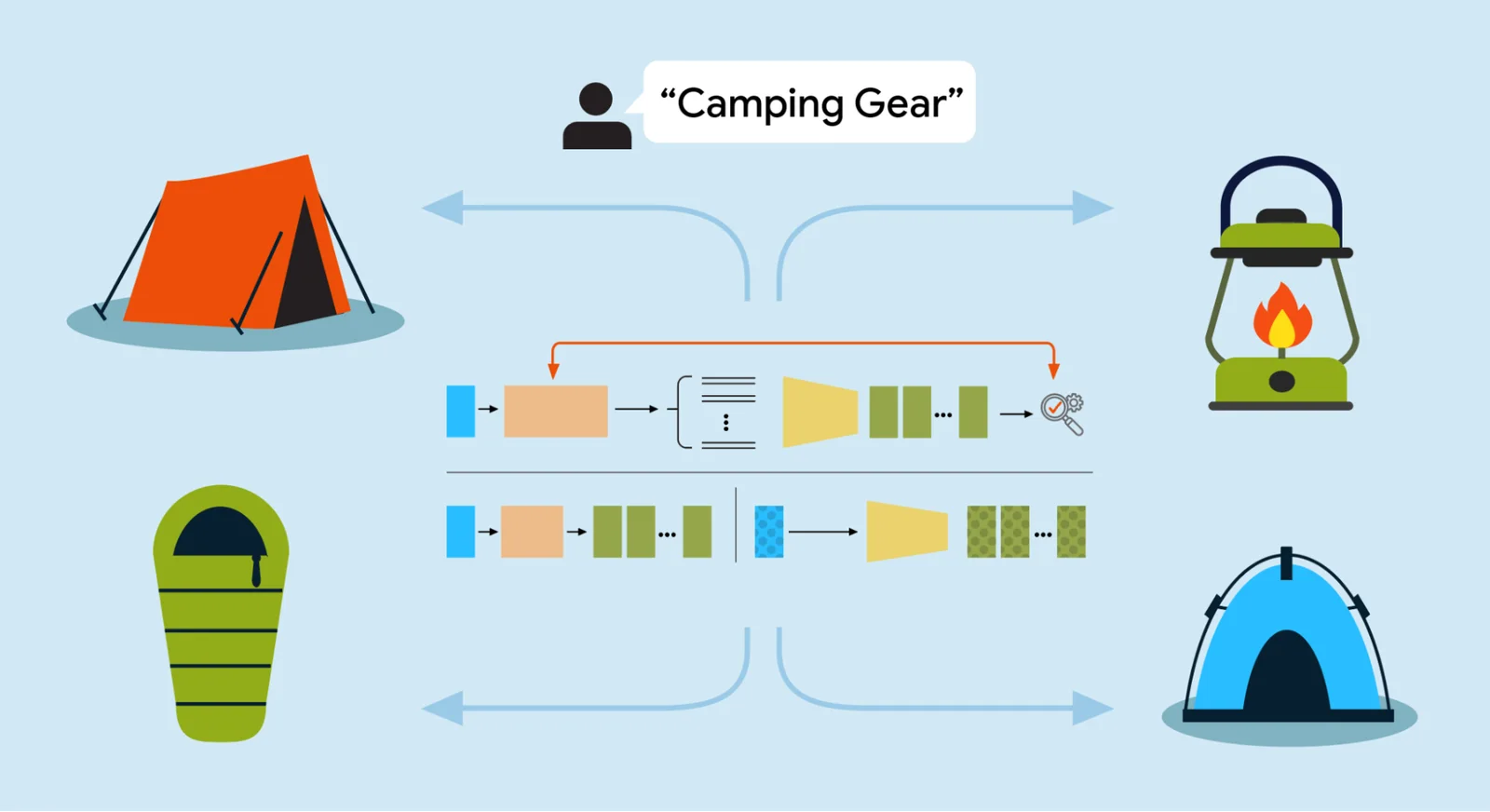
Modern search and recommendation applications are increasingly expected to return a coherent set of results rather than a single best match. For example, when a user searches for camping gear, they want a complementary slate that includes a tent, sleeping bag, portable stove, and headlamp, rather than ten variations of a four-person tent.
To achieve this, systems use query fan-out to break a broad prompt into related sub-queries. However, teaching a language model to perform this decomposition dynamically requires a massive thinking budget. Because zero-shot language models are general text predictors optimized for token-by-token generation, they need extended test-time computation to return a collection of results that optimizes properties like diversity and coherence while remaining grounded in a fixed database.
The challenge of standard language models
When deploying a standard language model at inference time to handle search expansion, developers encounter two major hurdles. The first is paraphrastic collapse, where the model generates redundant, near-synonymous queries instead of exploring complementary facets of a topic. For instance, a broad prompt about festival style might result in repetitive phrases like festival fashion and festival clothes, missing distinct directions like fringe jackets or suede boots.
The second challenge is autoregressive latency. Standard models generate hundreds of intermediate chain-of-thought reasoning tokens to plan their expansion before outputting search terms. While acceptable for conversational helpers, this sequential token generation creates a latency floor that conflicts with the sub-second response times required by production search bars.
The retrieve-for-train pipeline
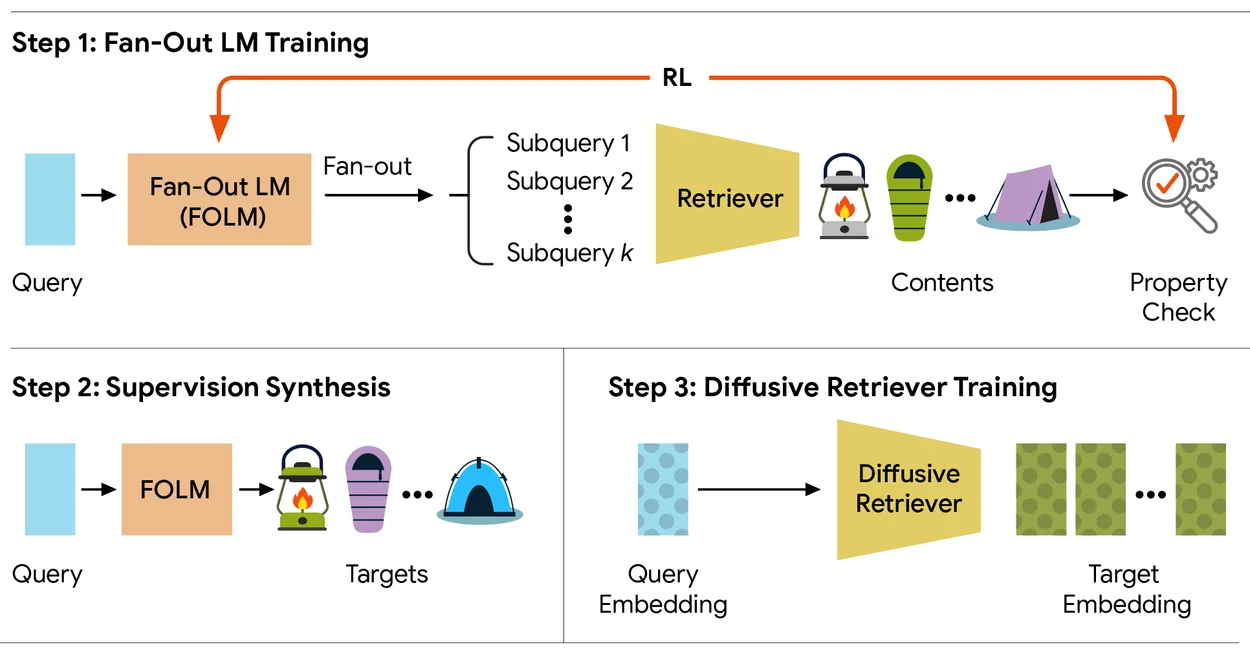
The retrieve-for-train framework treats AI training as an offline practice session rather than a real-time test. Instead of forcing the model to solve search rules while a user waits, the system runs an offline reinforcement learning program once to convert abstract goals into an exact instruction manual.
Source — Original announcement ↗
Worth a read?
Comments · 0