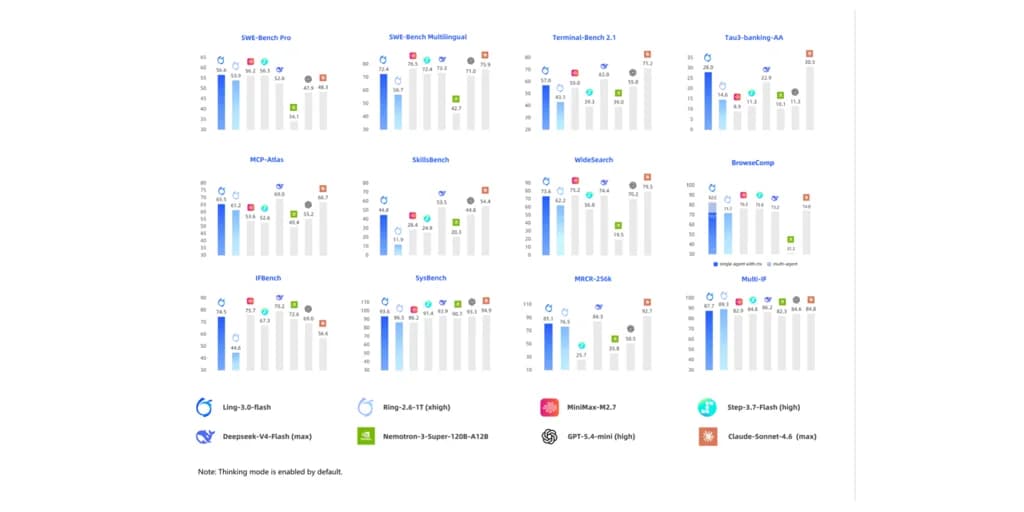
Ant Group releases Ling-3.0-Flash for agent workflows
Ant Group has introduced Ling-3.0-Flash, a 124-billion parameter hybrid-reasoning model optimized for high-speed agent execution. The model uses a sparse mixture-of-experts design to activate only 5.1 billion parameters per token while maintaining a 256K context window.
Published by Jin · 2 min read · 8 AUG 2026
- 124B
- 5.1B per token
- 256K native (scalable to 1M)
- KDA and MLA layers at a 5:1 ratio
Ant Group has announced the release of Ling-3.0-Flash, a new native hybrid-reasoning foundational model built specifically for production-grade AI agent workflows. Rather than focusing solely on massive parameter counts, the model is engineered to serve as a fast execution node that provides high intelligence density and cost-efficiency.
Architectural efficiency
Ling-3.0-Flash features 124 billion total parameters but activates only about 5.1 billion parameters per token. This configuration relies on a sparse mixture-of-experts — a design where only a small subset of the model's specialized sub-networks process each incoming token — which helps cut down on execution time and compute costs. The model moves away from traditional scaling methods by using a native hybrid-linear attention architecture that alternates KDA (Kimi Delta Attention) and MLA layers at a 5:1 ratio. This setup balances long-context efficiency with robust state memory, natively supporting a 256K context window that can scale up to one million tokens.
Built for agent workflows
Designed to support the planning-execution separation paradigm in AI workflows, Ling-3.0-Flash acts as a fast and stable execution node. It has been trained across more than 10,000 interactive environments, incorporating enhanced self-correction and long-horizon planning mechanisms to manage complex, multi-step tasks like coding, task decomposition, and deep research without losing context.
To ensure low latency during multi-turn interactions, Ant Group integrated a cluster-level hierarchical caching system that reduces Time-to-First-Token for long inputs by 60% to over 80%. The model is currently available on platforms like OpenRouter and Vercel AI Gateway, with free API access running through August 3, 2026, ahead of a planned open-source weight release.
Source — www.businesswire.com ↗
Worth a read?
Comments · 0