Triton low level extensions for production machine learning
Triton Low Level Extensions is a new software layer that gives engineers explicit control over GPU execution without abandoning Triton.
2 min read, Wednesday, 11 November

Triton Low Level Extensions, known as TLX, is an extension to the Triton programming language designed to help engineers optimize graphics processing unit performance. Modern hardware relies heavily on features like asynchronous memory movement and warp specialization to run efficiently. However, these capabilities often expose a gap between low-level control models and high-level productivity models. TLX aims to bridge this gap by offering explicit execution orchestration while keeping Triton's productive framework intact.
The evolution of hardware and programming models
Recent graphics processing units have evolved past simple execution models. NVIDIA Hopper introduced features like the Tensor Memory Accelerator and warp specialization, while Blackwell added tensor memory and cluster-level execution. These additions mean that high-performance kernels must coordinate multiple execution agents rather than relying on standard thread instructions.
Traditional models such as CUDA operate at a fine thread granularity that demands manual control over every relationship. On the other hand, Triton operates at a block granularity that turns many execution structures into implicit compiler choices. TLX occupies the middle ground, using Multiple Instructions, Multiple Warps as an abstraction where the warp group serves as the primary unit of orchestration.
Implementing explicit orchestration
Rather than forcing developers to adopt an entirely separate low-level language, TLX integrates directly into the existing tensor programming framework. Programmers use familiar high-level operations for calculations, while turning to TLX only when they need explicit control over synchronization and data movement.
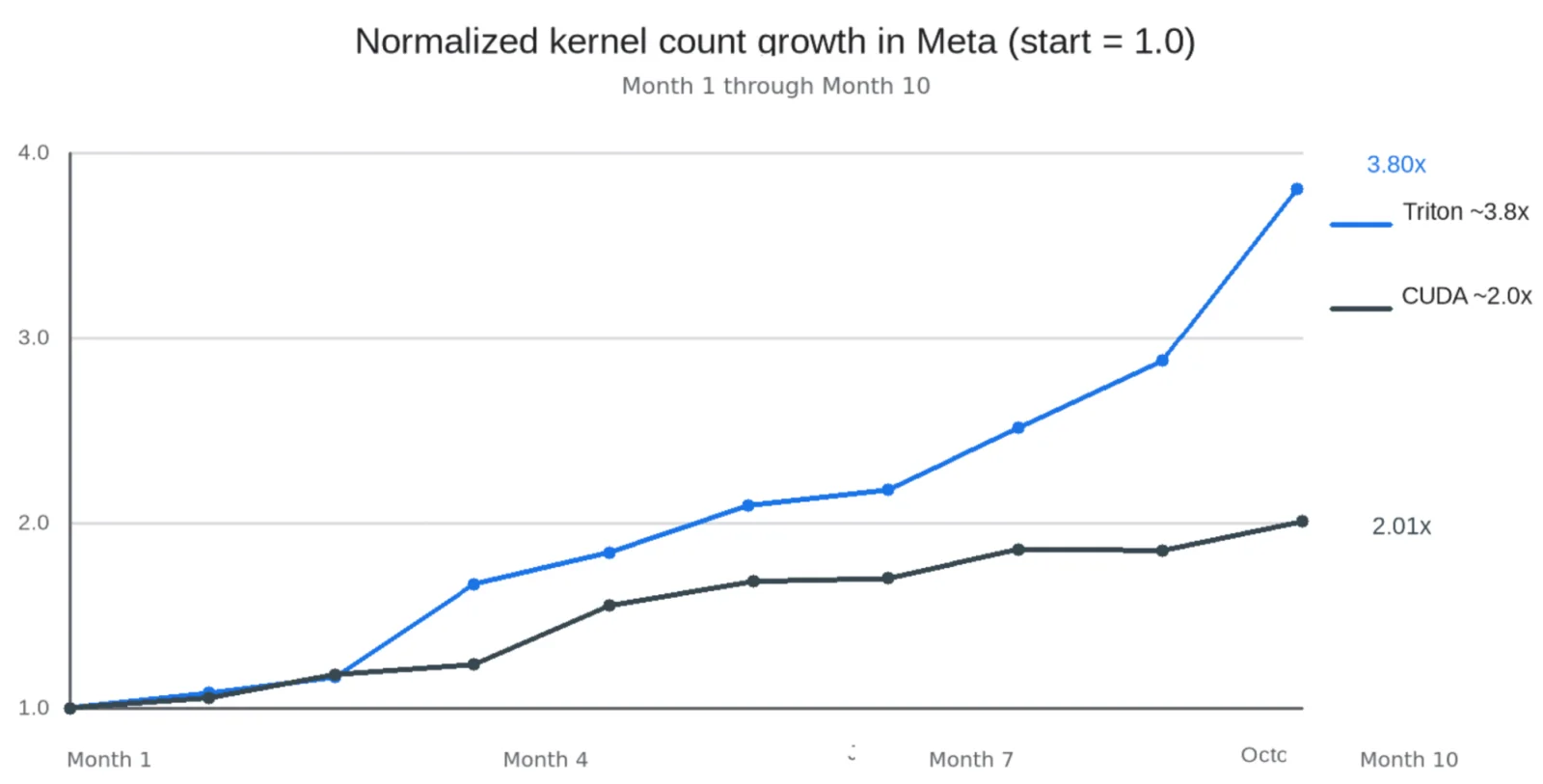
In standard Triton, execution follows a simple synchronous load and compute loop where each tile is processed and discarded sequentially. In contrast, TLX allows developers to separate tasks so that producer warp groups handle asynchronous data movement while consumer warp groups execute matrix multiplications using shared memory and lightweight barriers. This approach helps engineers optimize workloads ranging from recommendation system training to large language model pretraining across both NVIDIA and AMD accelerators.
Source: Original announcement
Worth a read?



Comments