Scaling machine learning innovations across ads ranking models with artificial intelligence agents
Meta is using autonomous artificial intelligence agents to propagate machine learning improvements across its ads ranking models.
2 min read, Wednesday, 18 November
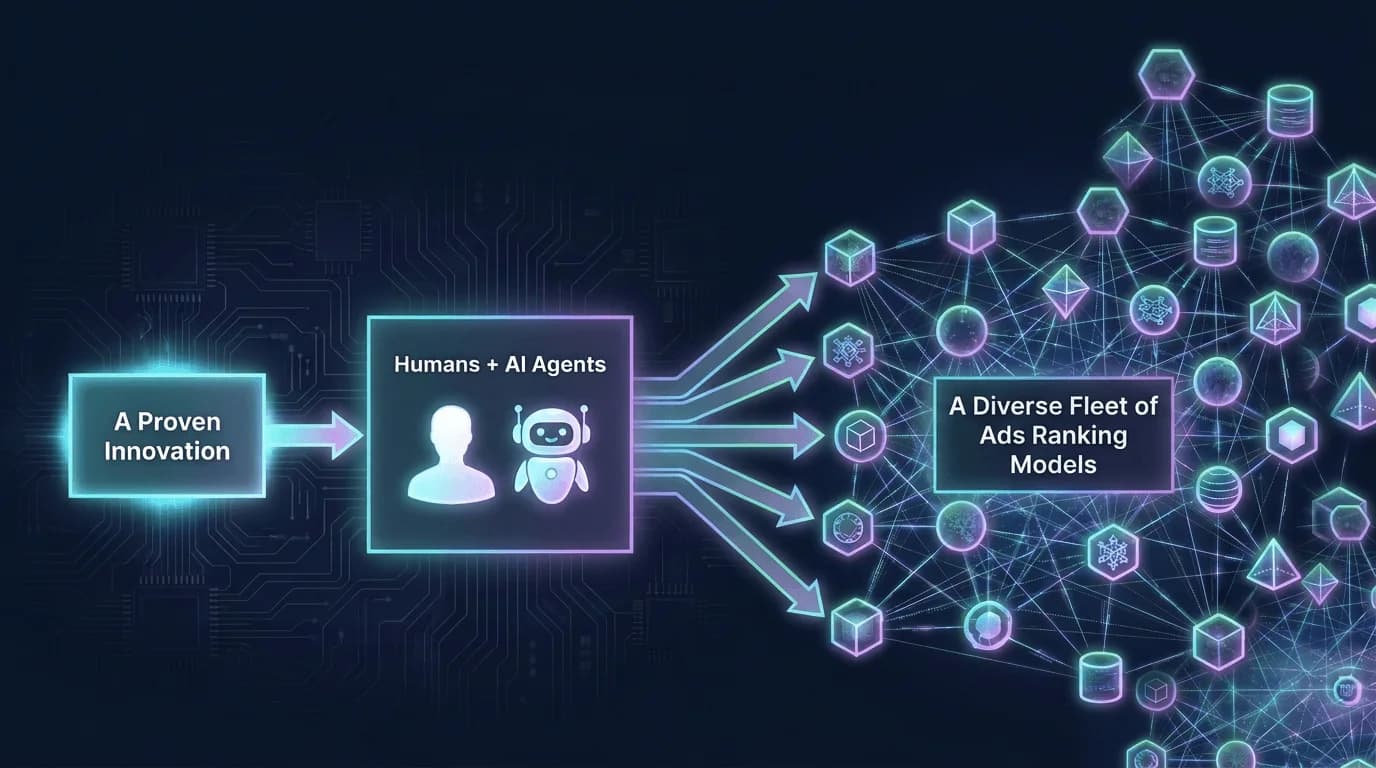
Meta relies on a diverse fleet of ads ranking models to power its recommendation systems. Each model serves different product surfaces and advertiser objectives, featuring distinct architectures, training data, and serving constraints. To keep these systems state-of-the-art, researchers constantly develop improvements called techniques, which include architectural advancements, richer data representations, and training optimizations.
Key facts
- Model Name
- Wukong
- Authors
- Buyun Zhang and 14 other authors
- Evaluation Datasets
- Six public datasets
- Model Complexity
- Extending beyond 100 GFLOP/example
The challenge of technique propagation
Because every model has its own constraints, a technique proven on one model almost never copy-pastes onto the next. Adapting these techniques manually requires deep domain expertise and creates a bottleneck where engineering bandwidth caps the speed of innovation. Furthermore, every adaptation requires a finite compute budget, meaning teams must carefully navigate a vast combinatorial space of potential configurations without wasting resources on suboptimal trials.
To overcome these hurdles, the organization has turned to artificial intelligence agents to automate the lifecycle of technique propagation. Operating since March 2026, these agents now handle over sixty percent of all technique propagation tasks across the model fleet.
How agents manage the workflow
The agentic system operates through three core capabilities:
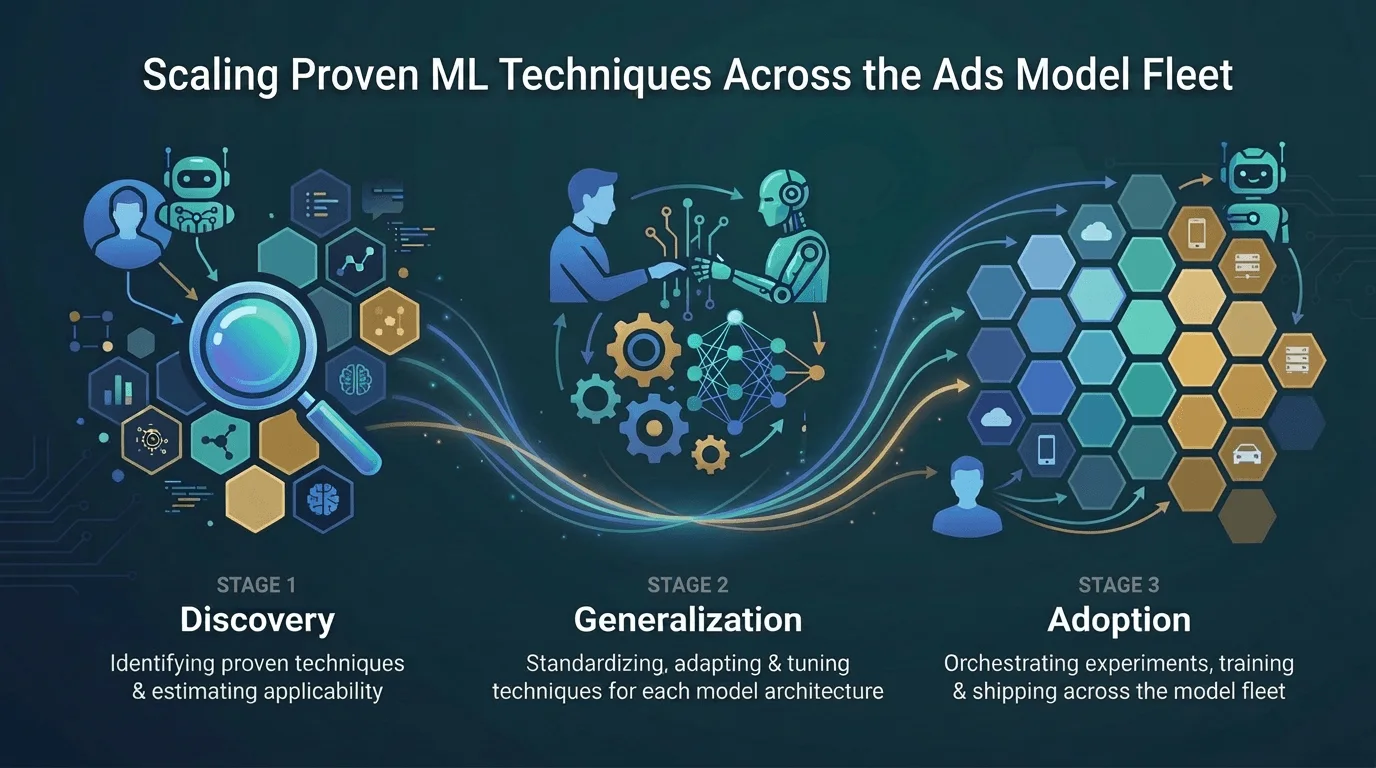
- Discovery: Agents continuously scan proven techniques, estimate their transferability, and rank potential combinations by expected impact using a shared knowledge base.
- Generalization: Agents help adapt techniques to new model architectures, either by improving reusable templates or by working alongside engineers on bespoke models to learn what configurations succeed.
- Adoption: Agents launch experiments, manage multi-day training runs, monitor convergence, diagnose infrastructure or training failures, and automatically apply targeted fixes.
Productivity and efficiency gains
By taking over judgment-heavy and non-deterministic tasks, the system allows human engineers to focus on high-level strategy and review processes. Early results show three times greater engineering productivity compared to manual workflows. Additionally, the agents intelligently narrow hyperparameter search spaces and stop unproductive training runs early, yielding a median four-fold reduction in training compute across select combinations and an estimated forty-five million dollars in compute savings by the end of the year.
Source: Original announcement
Worth a read?


Comments