Perplexity introduces Monitor API for continuous web tracking
Perplexity has launched a new application programming interface that automates recurring web searches and page tracking for artificial intelligence agents.
2 min read, Sunday, 22 November
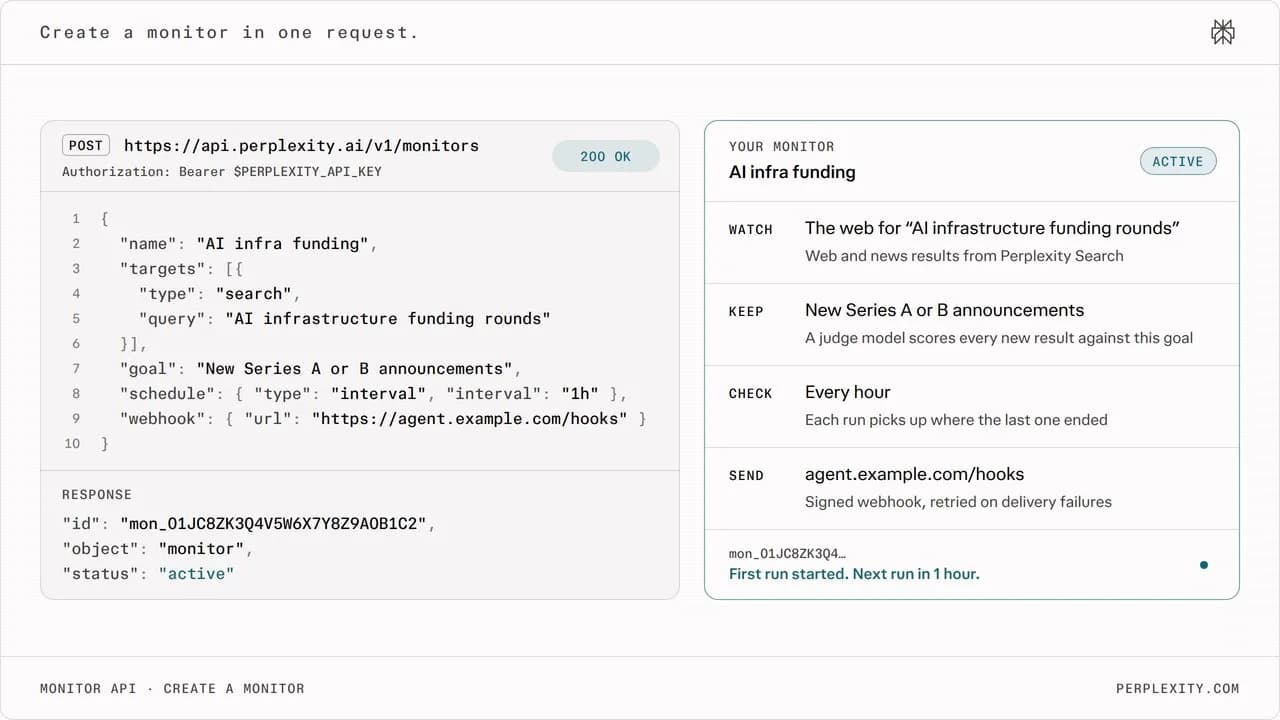
Perplexity has released a new tool designed to shift web search from a manual, one-off action into a continuous background process. The new Monitor API watches the internet on a set schedule and sends relevant updates directly to software applications and autonomous agents through webhooks — automated messages sent between systems when an event occurs.
Traditionally, engineering teams wanting to track web changes had to write custom code to run recurring searches, remove duplicates, and detect updates across multiple sources. Perplexity states that this maintenance becomes difficult when scaling to hundreds of topics or pages.
Key facts
- Web monitors cost
- $1 per 1,000 successful runs
- Page monitors cost
- $1 per 1,000 URLs fetched
- Page monitor limit
- Up to 10 specified pages
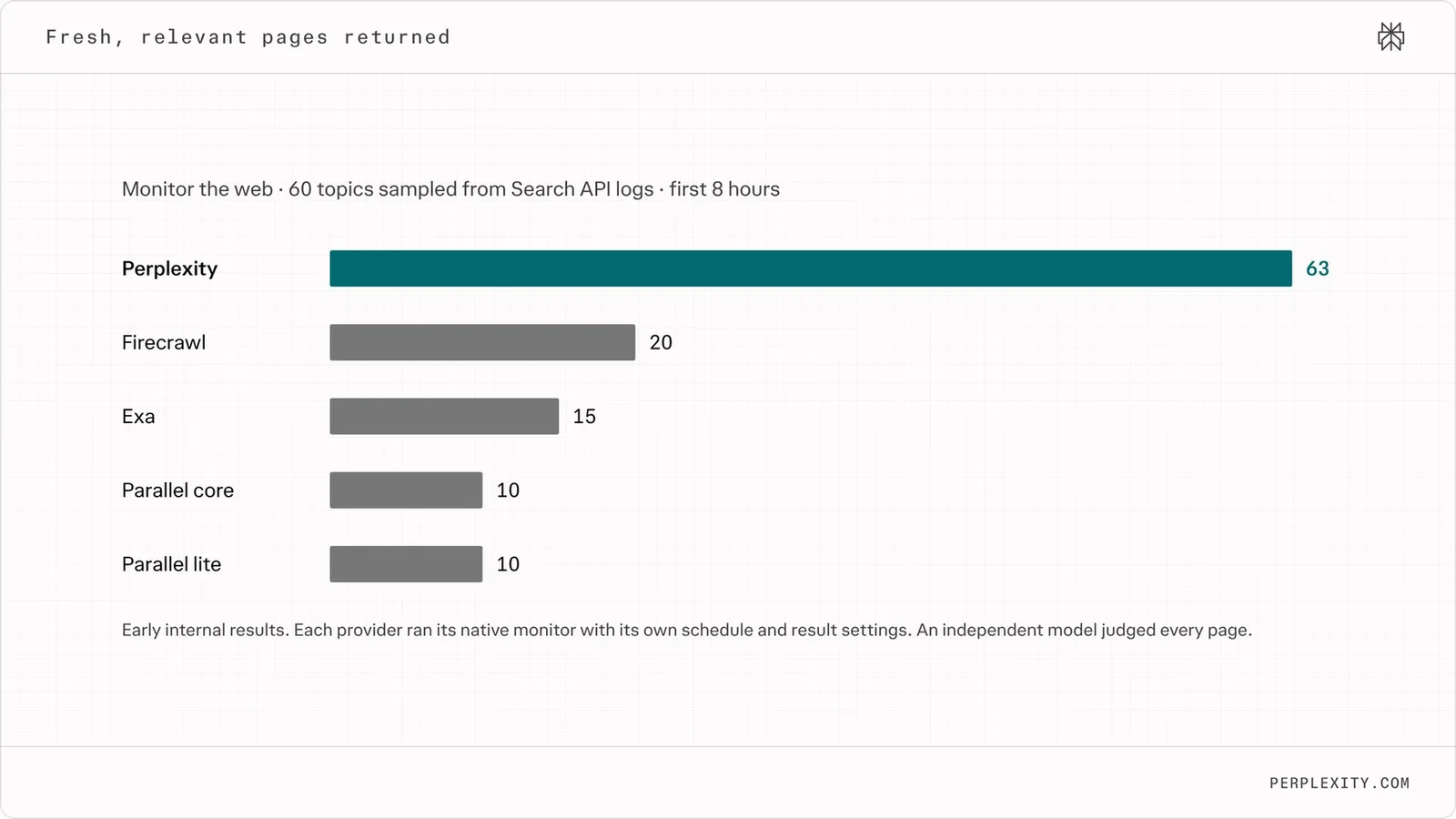
Two operating modes
The interface offers two distinct ways to track information:
- Web monitors run search queries through Perplexity's web and news search on a regular schedule to capture developments such as new funding rounds.
- Page monitors track up to 10 specific URLs, such as pricing tables or regulatory policies, capturing a baseline on the first run and returning text comparisons for subsequent checks.
Automated filtering and scheduling
To prevent information overload, Perplexity evaluates incoming results using an internal decision model. Developers define a goal in plain language, and the service screens web results against checks for relevance, source credibility, novelty, and timeliness. Page changes are similarly judged for their importance to the stated goal.
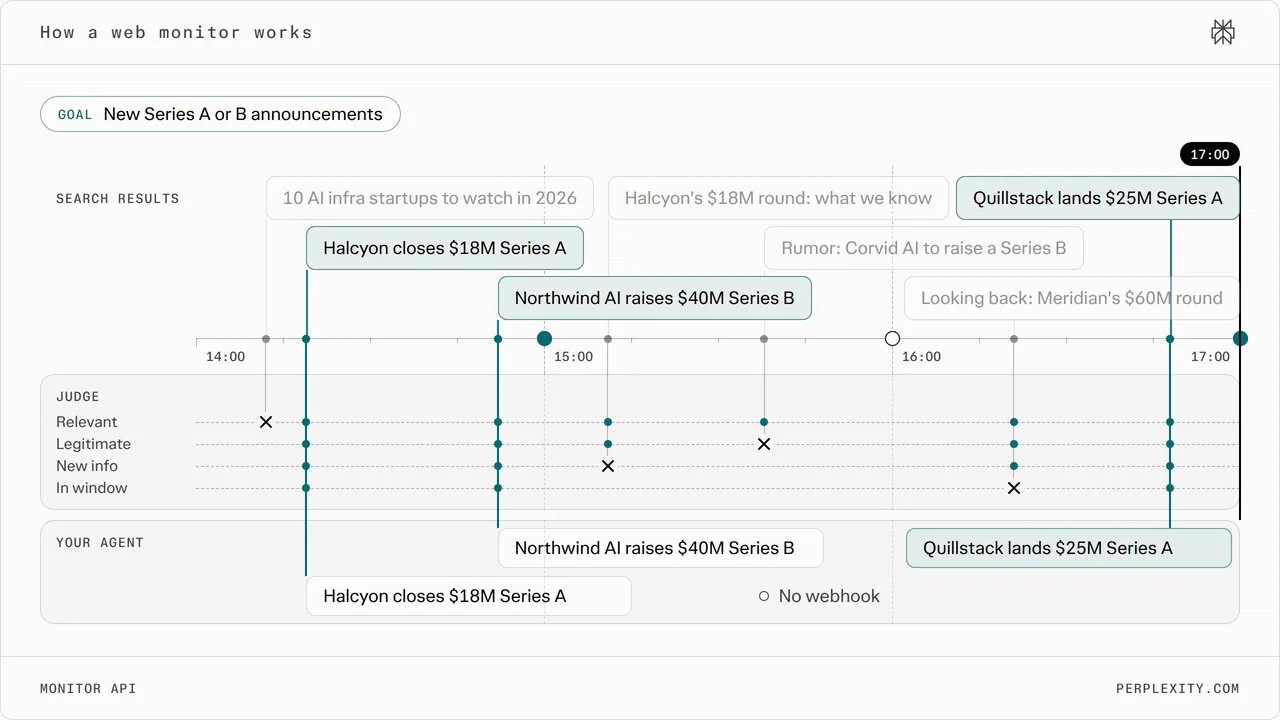
The system sends an update containing a confidence score only when every threshold is met. Developers can adjust these thresholds or change the tracking goal without recreating the monitor.
Schedules range from every fifteen minutes to weekly, or can be set using a custom cron schedule — a standard time-based job scheduler. The system automatically filters out duplicate results and retries webhook delivery if temporary errors occur.
Pricing and availability
The Monitor API is available now through the developer console, using the same authentication key as Perplexity's existing search and agent tools. Pricing is set at $1 per 1,000 successful runs for web monitors, and $1 per 1,000 fetched URLs for page monitors.
Source: Original announcement
Worth a read?


Comments