OpenAI introduces invisible text watermarking for EU compliance
OpenAI is rolling out invisible text watermarking for ChatGPT and Codex in the European Union to comply with new transparency rules. The method shapes word choices without affecting model performance, though editing and short passages can still hinder detection.
Published by Jin · 3 min read · 6 OCT 2026
- August 2
- textGrain
OpenAI is beginning to add an invisible watermark to text generated by ChatGPT and Codex within the European Union. This rollout is designed to comply with the European Union AI Act's transparency rules, which took effect on August 2 and require artificial intelligence companies to mark machine-generated content so other systems can identify it.
The update will reach eligible ChatGPT and Codex users across all plans in the EU over the coming weeks. For developers using OpenAI's application programming interface — which lets different software systems talk to each other — the watermark is available globally starting today but remains turned off by default. The company has decided against making text watermarking a global default at launch.
How the watermark works
The watermark does not appear as a visible symbol or badge on the screen. Instead, it works by subtly shaping the model's word choices. This leaves an invisible pattern that readers cannot see, but a specialized detector can pick up. Because the watermark lives directly inside the words, it travels with the text even when copied and pasted elsewhere. OpenAI reported seeing no meaningful change in model performance with the feature turned on, and confirmed it does not identify individual users.
Alongside this announcement, the company published a technical report detailing its method, called textGrain. Co-written with researchers from the University of Pennsylvania and Yale, the report describes how a secret key is used to sort next-word predictions during sentence generation. Combining hundreds of these subtle nudges allows a detector to spot artificial intelligence-generated content using only the text and the key.
Limitations and reliability
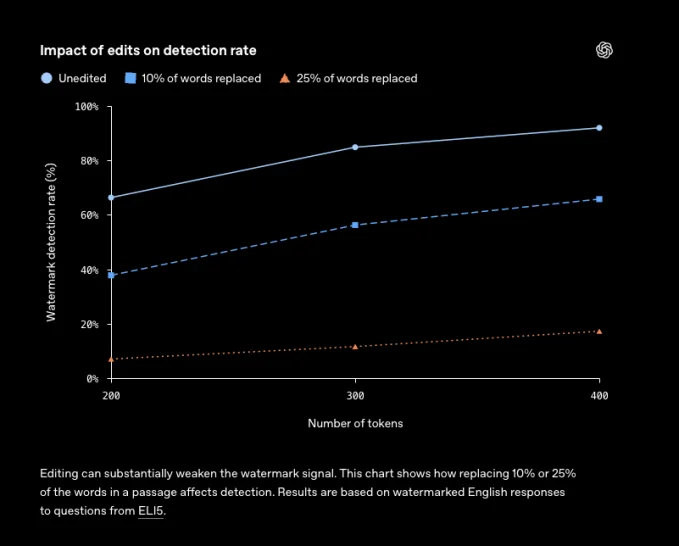
OpenAI's internal tests indicate that the watermark can be disrupted or removed by editing. In one evaluation, replacing 10% of the text's words with synonyms dropped detection rates from approximately 92% to 66%. Furthermore, short passages, math answers, and translated text remain notably harder to detect.
Source — Original announcement ↗
Worth a read?
Comments · 0