On-device agent deployment with LFM2.5-2.6B
LFM2.5-2.6B is a compact, open-weight model designed to power multi-step agent workflows and tool-calling capabilities entirely on edge devices. By utilizing advanced multi-domain distillation and agentic reinforcement learning, it achieves competitive performance against models up to four times its size.
Published by Jin · 2 min read · 6 AUG 2026
LFM2.5-2.6B is a 2.6-billion-parameter model designed to power capable autonomous agents entirely on-device. Supporting tool calling and multi-step workflows, the model remains small and fast enough for everyday hardware ranging from standard laptops to mobile phones. This allows developers to deploy functional agents locally, maintain complete data privacy, and scale usage without incurring cloud inference bills.
Training architecture
The model is pre-trained on approximately 34 trillion tokens, utilizing a mid-training phase that extends the context window to 128K tokens. The post-training process transforms the base model into an agentic system through four distinct stages: supervised fine-tuning focused heavily on tool use and web search, teacher specialization across distinct domains, multi-domain on-policy distillation, and agentic reinforcement learning.
The agentic reinforcement learning pipeline executes multi-turn reinforcement learning inside real agent harnesses. It isolates model optimization, inference, and environment execution into separate components. This approach lets the system train within black-box agent harnesses like OpenClaw or Hermes Agent without modification, capturing token-level trajectories to validate training samples effectively.
Benchmark performance
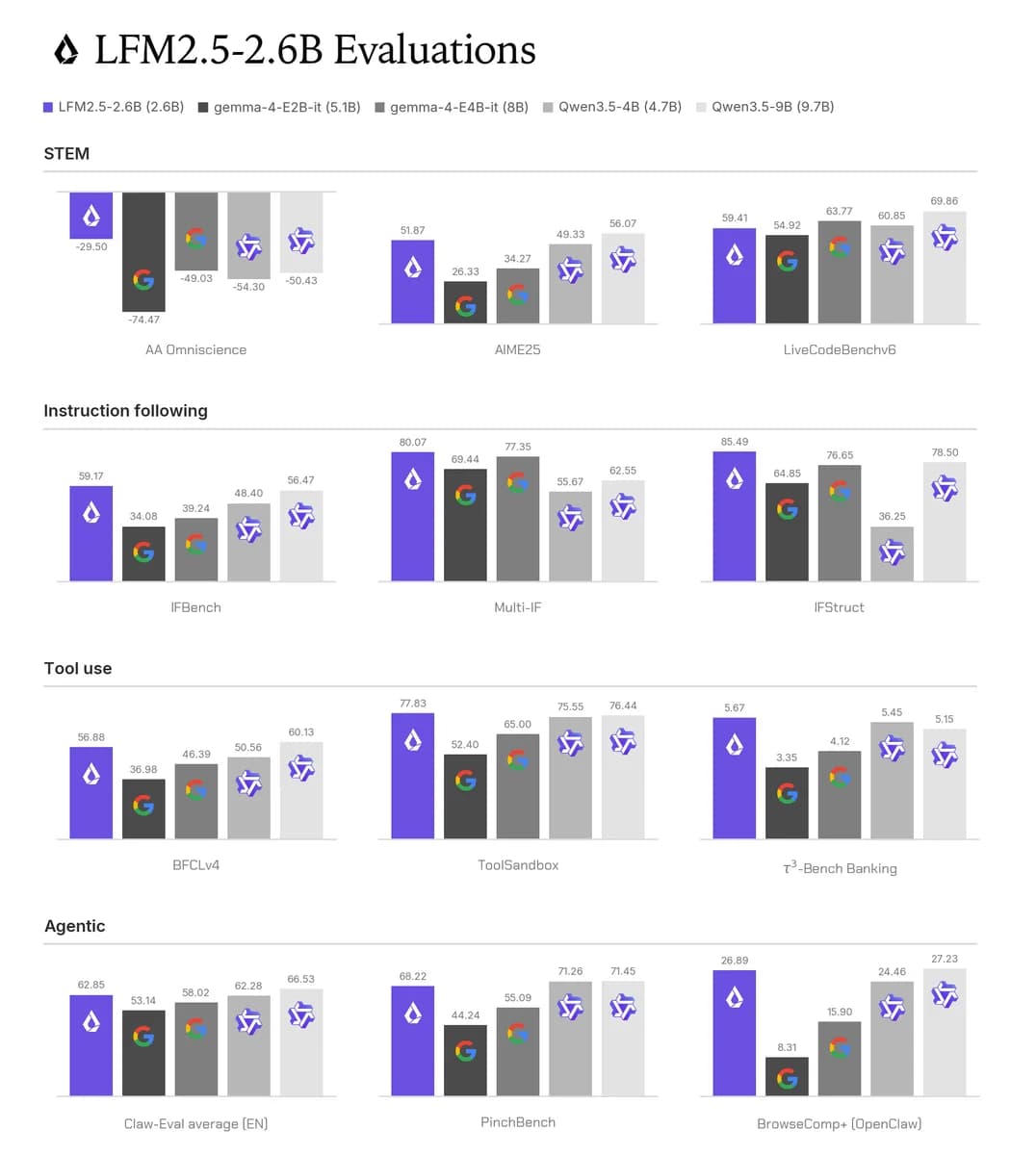
Evaluated against models up to four times its size, LFM2.5-2.6B demonstrates strong results across instruction following and tool use. It leads several instruction-following benchmarks and remains competitive on agentic tasks, outperforming comparable Gemma models and tracking closely with larger Qwen models. However, larger models retain an advantage in standalone coding tasks.
Inference efficiency
Day-one support is available across major inference frameworks including llama.cpp, MLX, vLLM, SGLang, and ONNX. On CPU hardware, decode speeds reach 220 tokens per second on an Apple M5 Max and 113 tokens per second on an AMD Ryzen AI Max+ 395. At roughly 30 tokens per second, the model can run capable agents directly on mobile phones. On GPU infrastructure, it achieves high concurrency throughput suitable for heavy production workloads.
Getting started
Both the base and instruction-tuned variants of LFM2.5-2.6B are available on Hugging Face. Developers can integrate the model using standard libraries such as Hugging Face transformers with a bfloat16 configuration, making local agent deployment accessible for a wide range of edge applications.
Source — Original announcement ↗
Worth a read?
Comments · 0